 Property Week News, analysis, insight and events for UK property professionals
The Clash famously asked, ‘Should I stay or should I go?’ back in 1982, with the song capturing the frustration of indecision.

Andrew German is partner at Sheppard Robson
More than four decades later, the same question remains of interest to occupiers across the commercial property industry: should they stay and renegotiate their lease, or relocate?
We have noticed that the answer to that question is shifting. Ten years ago, the pattern was predictable. As lease ends approached, the presumption was that occupiers would start searching for their next office. The appeal of somewhere new was strong: a fresh start, a chance to rethink the workplace strategy and the prospect of that ‘shiny new office’ feeling.
But things have changed. Rather than automatically planning their exit, occupiers are increasingly considering how they can stay and renegotiate their lease.
Occupiers are acutely aware that embodied carbon in existing buildings is already ‘spent’
This shift has multiple drivers. The sustainability agenda has moved from nice-to-have to business-critical. Occupiers are acutely aware that embodied carbon in existing buildings is already ‘spent’, and ESG strategies now carry real weight in boardroom decisions. A ‘stay’ strategy can create a carbon-conscious workplace that embeds circular economy principles and adaptive reuse.
To quote the Clash again, “If I go there will be trouble, and if I stay, it will be double”, which highlights that the stay option doesn’t come without its own pain.
Staying put during a refurbishment is disruptive. It is a process that affects daily operations, and for businesses where people are the key priority, this disruption needs careful management. The challenge of retaining and attracting talent while the office undergoes works is significant and should not be underestimated.
The design needs to be underpinned by a robust change management strategy. This becomes critical in highly technical spaces such as trading floors, where continuous operation is essential. The phasing, temporary relocations within the building and technology migrations all require forensic planning. A mis-step in sequencing can have serious operational consequences.
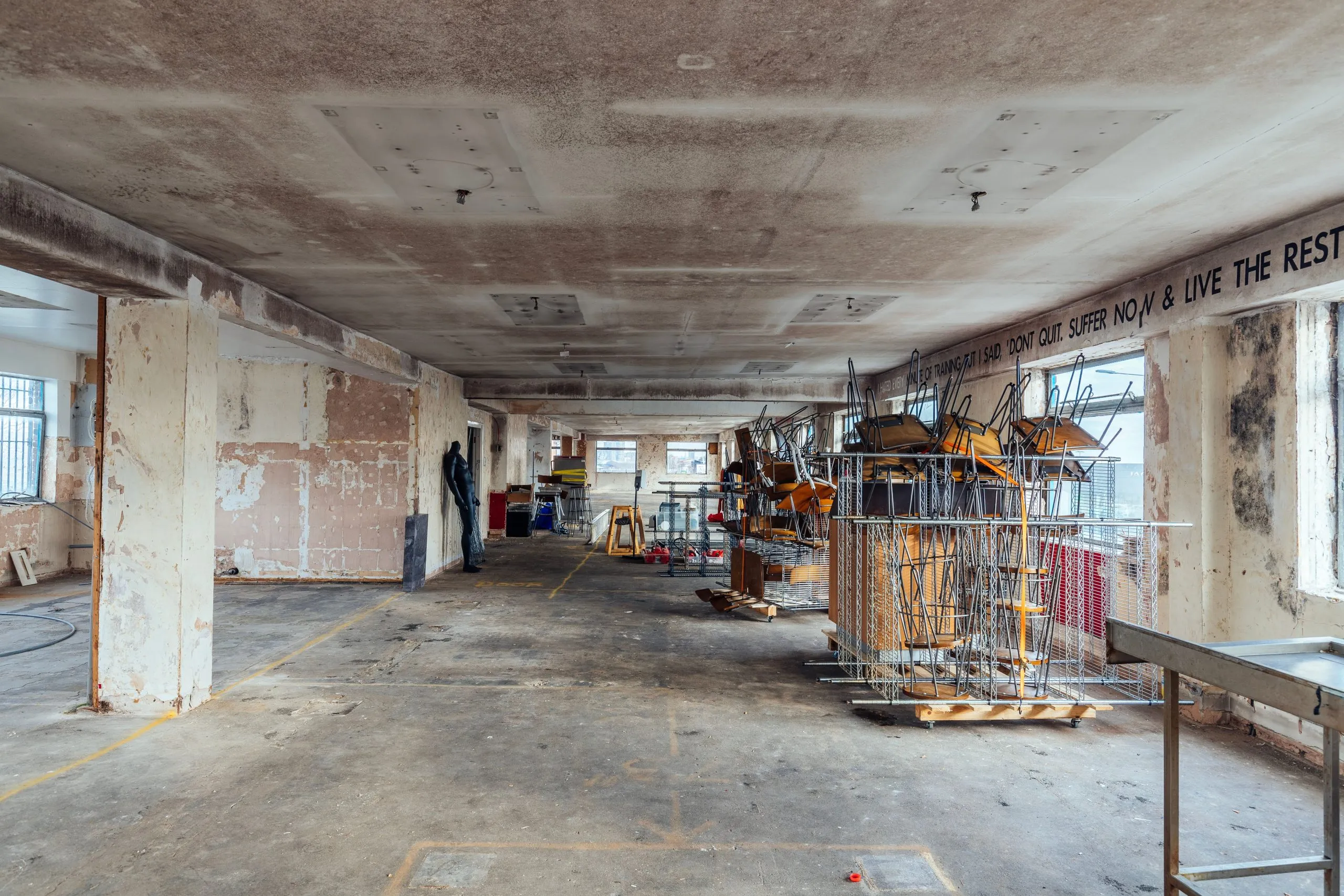
Hard at work: refurbishing a building where tenants are in place can be tricky to manage
The occupiers we work with have varying appetites for change. Some want a relatively light-touch intervention – they value the continuity of their existing space and want to introduce better technology or a broader range of work settings, while maintaining familiarity.
Others want to stay in the same location but signal a complete departure from their old office. They’re looking for a bold rethink of their space – perhaps to communicate a new chapter in their business’s history. This often involves significant changes to the base build: enhanced end-of-trip facilities; new connecting staircases between floors; the replacement of end-of-life infrastructure and mechanical services. These ambitions add complexity, particularly in negotiations between landlord and tenant.
Motivating factors
From the developer’s side, there is often strong motivation to keep a good tenant with a solid covenant. A lease renewal and extension provides income certainty and avoids void periods. However, these conversations require careful navigation. The division of base-build improvements between landlord and tenant contributions needs a clear agreement from the outset.
Both parties need to be realistic about timescales and costs. A refurbishment in place almost always takes longer than a straightforward fit-out of an empty floor. The complexities of occupied buildings – working around tenants, phased access, protecting operational areas – must be factored into programmes and budgets from day one.
My role involves working both sides of this equation: advising occupiers on their estate strategies and helping developers prepare their buildings to be attractive to tenants. The stay-or-go decision is becoming more nuanced. The automatic assumption of moving has gone, with the evaluation process now centring on carbon impact, business continuity, cost and long-term flexibility.
The occupiers that get this right are those that plan early, engage their stakeholders honestly about the challenges ahead and commit fully to the change management process. Staying might increasingly be the more sustainable option, but don’t mistake that for an easy choice.
Andrew German is partner at Sheppard Robson