 Property Week News, analysis, insight and events for UK property professionals
Faraby Farid, technical lead for real estate developments and energy strategy at The Crown Estate, has over 20 years’ experience designing industry-leading buildings and developments. Significant accolades in his career include 8 Bishopsgate in London, the first tall building in the UK to achieve BREEAM 'Outstanding', and the National Museum of Qatar, renowned for its architectural beauty and design excellence. This range of experience inspired him to think about how building development can be undertaken to its best degree, even in the most unusual environments, the desert for example.
This brought him to think more systemically about performance, particularly in a sustainability context. He decided that achieving the impact he wanted to make required a move from project-by-project work to having influence over engineering design in a whole part of a city. That led him to The Crown Estate to work across its portfolio of historic buildings in London.
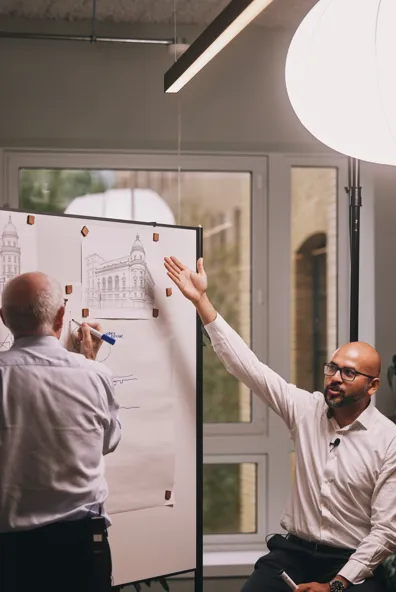
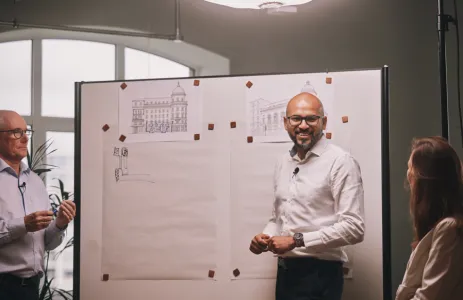
In an exclusive video podcast sketch session, Farid joins Roger Olsen, Artus Air inventor, and Rebecca Stewart, chief executive of Artus Air, to explore some of the design conundrums he faces to bring these historic buildings into the modern day, to make them sustainable, functional, desirable and commercially viable. And, of course, to stand the test of time.
At the centre of this conversation is the mindset shift needed for responsible retrofit. No longer is it simply a technical exercise; it is becoming a strategic balance between preserving heritage, optimising fabric performance and quality thinking at a city scale, while ensuring cost efficiency does not undermine quality or performance.
Breathing new life into heritage buildings
Historic buildings were never designed for today’s expectations of comfort, energy efficiency and resilience. Yet they remain some of the most valuable and character-rich assets in our cities. From former warehouses turned offices to theatres repurposed as workplaces, the challenge lies in adapting these structures without losing what makes them unique.
Farid frames this as an opportunity rather than a constraint. His work focuses on “giving another 100 years to heritage buildings” by aligning preservation with performance, the right solutions and commercial viability.
A key principle in this approach is prioritising the building fabric. As Olsen puts it: “Before you talk about a system, you have to look at the building first.”
Improving elements such as glazing, insulation and solar control can dramatically reduce heating and cooling demands before mechanical systems are even introduced. In heritage contexts, these interventions must be carefully balanced – choosing between internal or external insulation, managing ventilation in noisy urban environments and preserving architectural integrity.
These early decisions have long-term consequences. Creating a stronger building envelope helps to maintain the heritage of historic assets, particularly facades.
To complement this, water-based heating and cooling systems that do not require bulky plants enable more green spaces on roofs. Water-based, packaged systems maintain floor-to-ceiling heights because of their compact form factor and ability to operate without bulky ductwork. New, enhanced heating and cooling systems allow the original heritage aesthetics of the building to endure inside and out, while being kinder to the environment and delivering more operational value.
Ultimately, preserving heritage is not about freezing buildings in time. It is about enabling them to evolve comfortably, efficiently and sustainably so they remain desirable, energy efficient and viable for generations to come.
For these reasons, Artus Air was selected for The Crown Estate heritage projects including the refurbishments of 16 New Burlington Place and New Zealand House, both in central London.
Beyond the building: a system-wide approach for net zero roadmaps
While individual building performance remains important, there is growing recognition that the future of retrofit lies beyond the building itself. Cities are increasingly shaping how buildings function, particularly as climate pressures intensify.
Urban heat islands, rising temperatures and growing cooling demand are forcing a rethink of energy infrastructure. Heat maps of cities like London reveal significant variations in demand across districts, highlighting the need for more co-ordinated, system-wide solutions.
As Farid explains: “We have to think beyond the building and start thinking at city scale.”
This shift is already visible in the rise of district energy networks. Paris, for example, operates one of Europe’s oldest district cooling systems, supplying large parts of the city through centralised infrastructure. Across Europe, such networks already serve around 60 million people and are expected to expand as cities decarbonise.
These collective models offer significant advantages. Instead of each building installing oversized systems designed for peak demand, shared infrastructure allows capacity to be distributed more efficiently. Thermal storage and networked systems can respond to fluctuating needs, reducing both carbon emissions and capital expenditure.
For developers and asset owners, this means rethinking the boundaries of responsibility. Building performance is no longer defined solely by what happens within the envelope, but by how effectively a building connects to wider urban systems.
This system-wide approach also supports broader policy goals. The UK government has identified district cooling and similar solutions as key enablers of net zero, reinforcing the importance of collaboration between developers, planners and infrastructure providers.
In this context, retrofit becomes part of a larger urban strategy, one that aligns individual projects with the long-term resilience of entire cities.
Value redefined: is cost still king?
Cost has always been a central consideration in development, but what constitutes ‘good value’ is changing. Traditional models focused heavily on minimising upfront capital expenditure. Today, that approach is being challenged by a more holistic understanding of value.
Farid highlights this shift clearly: “We need to have the cost, carbon and let-ability considerations on the same sheet.”
This means looking beyond initial installation costs to consider operational efficiency, regulatory compliance and long-term asset performance. As Stewart notes: “Development often stops at practical completion, but building systems need to work for decades.”
What appears cost-effective in the short term can introduce hidden risks. For example, as regulatory pressure on F-Gas legislation tightens, existing systems reliant on refrigerants face replacement or redundancy costs. Maintenance costs, compliance requirements and future retrofits can quickly erode any initial savings.
This has sparked a broader debate between picking lower cost solutions versus what Farid deems “doing things properly”. Increasingly, developers are recognising that investing in higher-quality systems, such as water-based cooling rather than refrigerant-heavy alternatives, can deliver better long-term outcomes, both financially and environmentally.
Fabric-first strategies also play a role here. By reducing energy demand at source, they enable smaller, more efficient systems, freeing up valuable space and improving occupant comfort. This can translate into higher-quality lettable space and stronger returns over time.
As Farid observes, thinking differently is key: “If you think outside the box and do something differently, you can achieve better outcomes.”
The result is a shift from short-term cost optimisation to long-term value creation, where resilience, performance and user experience are as important as initial budgets.
Setting new standards for the next 100 years
Retrofitting heritage buildings is not about a single solution or technology. It requires a careful balance between preservation, performance and practicality set against the backdrop of evolving cities and climate challenges. This is a responsibility that Farid highlights very clearly in the role The Crown Estate has in London: “It’s about sustainability and keeping our assets alive for as long as possible and creating the best quality of spaces.”
The most successful projects are those that start with the building fabric, consider their place within the wider urban system and take a long-term view of cost and value.
Many of the buildings being adapted today are still expected to be standing in a century’s time. Ensuring they remain comfortable, efficient and commercially viable will depend on the decisions made now.
In the end, the goal is not simply to retrofit buildings but to future-proof them, creating a benchmark for spaces that respect their past while being ready for the demands of the next 100 years.
—–
This article is based on a conversation between Faraby Farid and Rebecca Stewart, chief executive of Artus Air, in Episode 3 of Retrofitting Our Reality. Across the series, Stewart explores how design, engineering and leadership choices shape buildings to perform in practice, not just on paper. With 28 years’ experience taking new ideas to market, from Aston Martin to Arup to Artus Air, she brings a focus on meaningful innovation, occupant comfort and lower-carbon outcomes.
Faraby Farid is technical lead for real estate developments and energy strategy at The Crown Estate