 Property Week News, analysis, insight and events for UK property professionals
For developers and investors navigating today’s commercial property market, performance is no longer judged solely on location or specification.
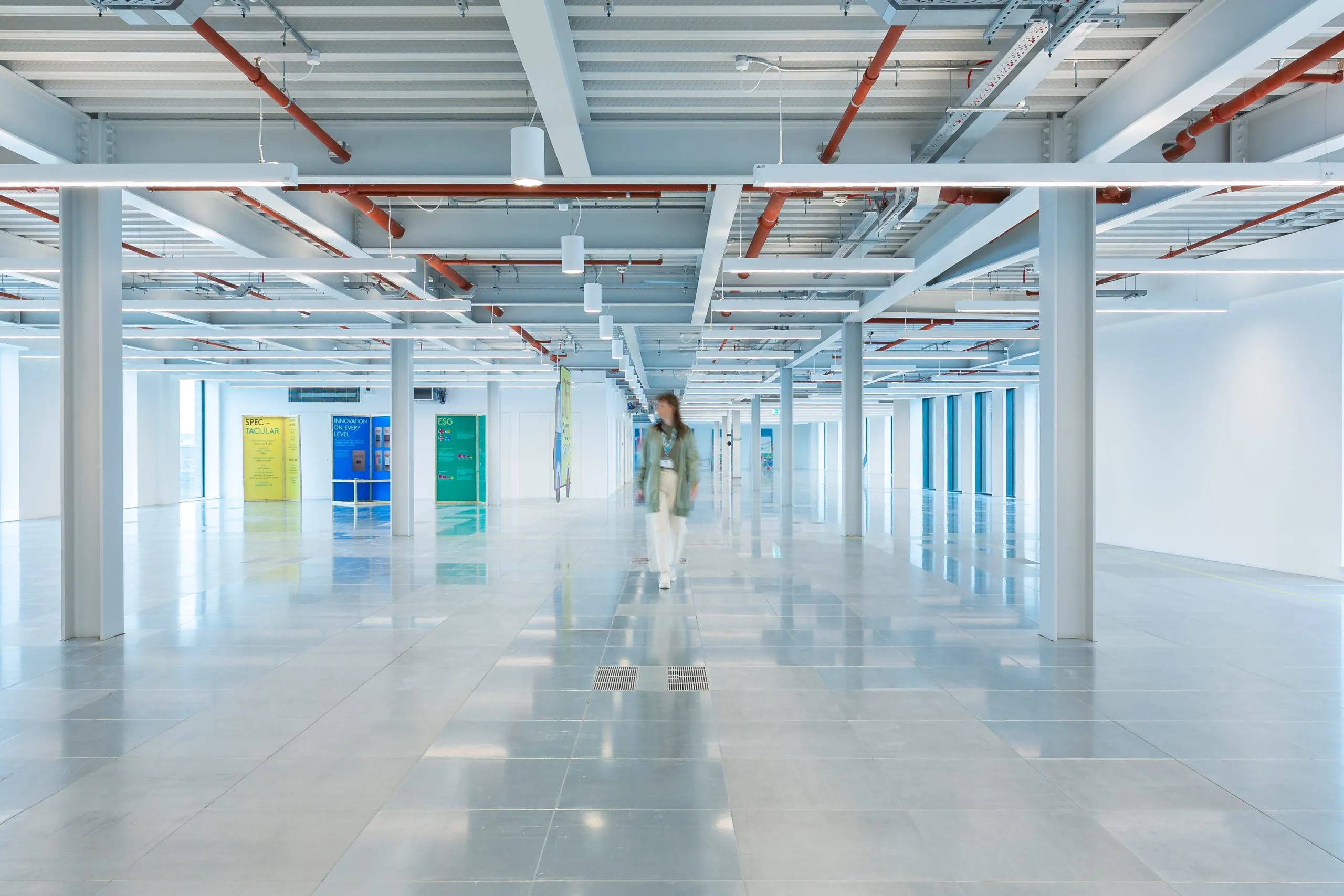
Tower Bridge Court
Carbon intensity, adaptability, operational efficiency and long-term resilience now sit at the heart of value – and decisions made at building-services level can have a disproportionate impact on all four.
Underfloor air conditioning (UfAC) has long been recognised for its design and comfort benefits. What is increasingly clear, supported by independent analysis, is that UfAC also delivers measurable commercial and sustainability advantages that align closely with investor and developer priorities.
Designing flexibility into the asset
One of UfAC’s most immediate advantages is the architectural freedom it affords. By distributing air via the raised-access floor rather than through extensive ceiling ductwork, UfAC enables clean, uncluttered soffits, increased penetration of natural daylight and maximised floor-to-ceiling heights. These qualities support bright, spacious working environments that are easier to let and more appealing to occupiers.
Crucially, this flexibility extends beyond first occupation. UfAC systems are modular and easily reconfigured, allowing cat-A and cat-B layouts to evolve without the disruption and cost associated with reworking high-level services. For landlords, that adaptability reduces churn and waste while enabling rapid response to changing tenant requirements – a critical advantage in a market shaped by hybrid working and shorter lease cycles.
Sustainability with quantified impact
As sustainability performance comes under increasing scrutiny from planners, lenders and occupiers, developers are under pressure to demonstrate real, verifiable outcomes. Independent modelling by WSP confirms that UfAC delivers meaningful carbon savings across the building lifecycle.
Compared with conventional heating, ventilation and air-conditioning (HVAC) solutions, UfAC can achieve up to an 18% reduction in upfront carbon, alongside 9% to 16% savings in whole-life embodied carbon (A-C stages, excluding operational energy). These reductions are driven not only by the HVAC system itself, but by the wider efficiencies UfAC enables, including reduced ductwork, simplified service zones and lower material intensity across the building fabric.
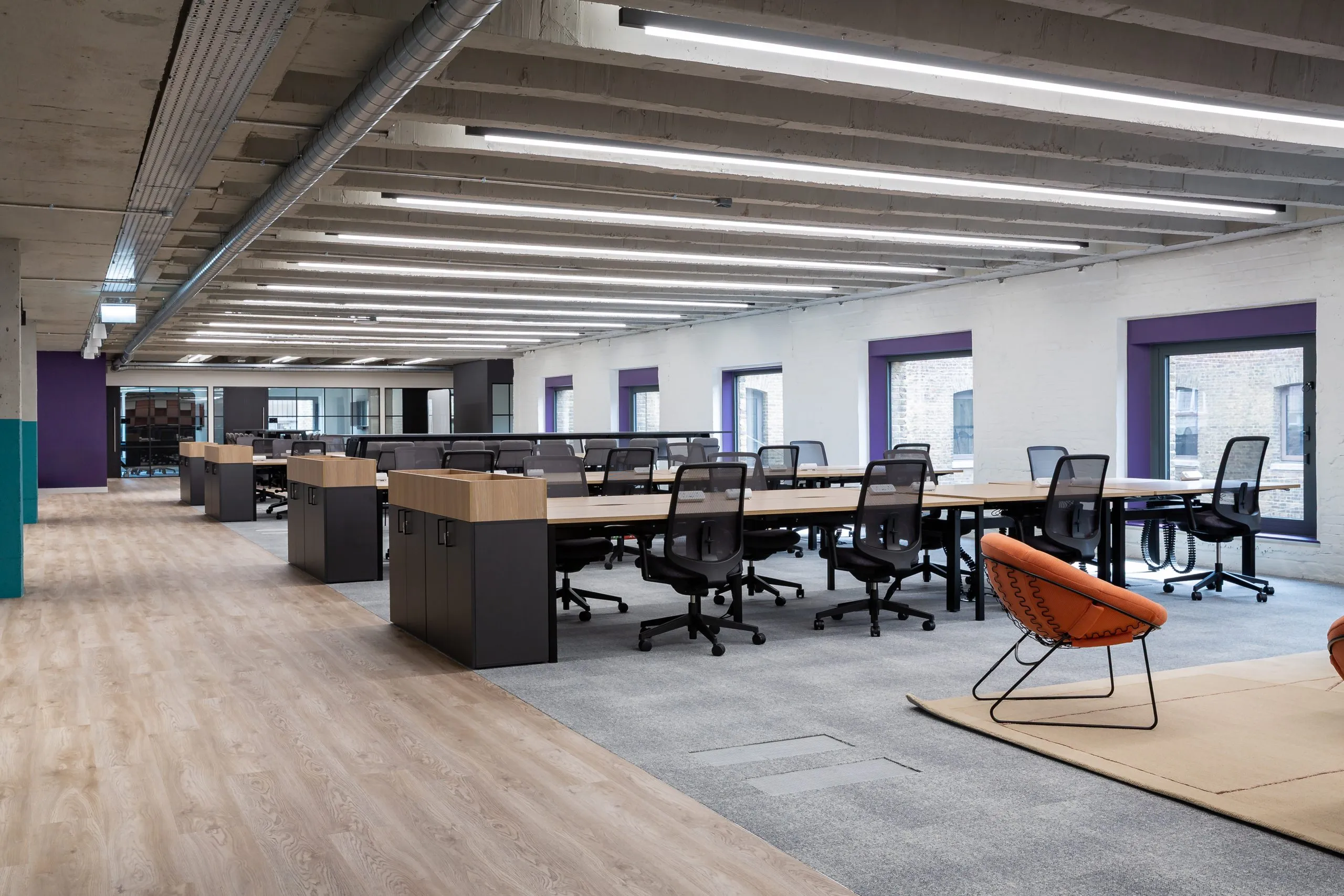
9 Devonshire Square
Operational performance also improves. Depending on system configuration, UfAC delivers 3% to 19% reductions in total operational energy use, supporting lower in-use carbon emissions and reduced running costs over the life of the asset. For long-hold investors, the combined impact on embodied and operational carbon strengthens environmental, social and governance (ESG) credentials while improving long-term cost certainty.
As Karl Stauss, head of client delivery at AET Flexible Space, explains: “On live projects, the sustainability gains come from very practical decisions. When you strip out ceiling ductwork and consolidate services into the floor, you’re immediately reducing material use, transport, installation time and site waste — and that has a real impact on embodied carbon before the building is even occupied.
“What we see in operation is a system that’s inherently more efficient and easier to control, so buildings use less energy day to day and perform more consistently against carbon targets. Just as importantly, the space remains adaptable – layouts can change, tenants can evolve and the building doesn’t need to be ripped apart to keep up. That’s where long-term carbon savings really stack up.”
Unlocking value in new-build developments
For new-build schemes in particular, the benefits of UfAC extend beyond services efficiency into building-level cost and carbon savings. WSP’s analysis demonstrates that reduced service void requirements allow slab-to-slab heights to be reduced by up to 14%, while maintaining – and in some cases increasing – floor-to-ceiling heights.
This reduction has a direct impact on the superstructure and facade, cutting material quantities and delivering up to 16% to 18% savings in embodied carbon at a building scale. It also translates into tangible financial value: on a typical 10-storey office building, the study identifies up to £1.7m in upfront cost savings, driven by efficiencies in structure, envelope and associated construction elements.
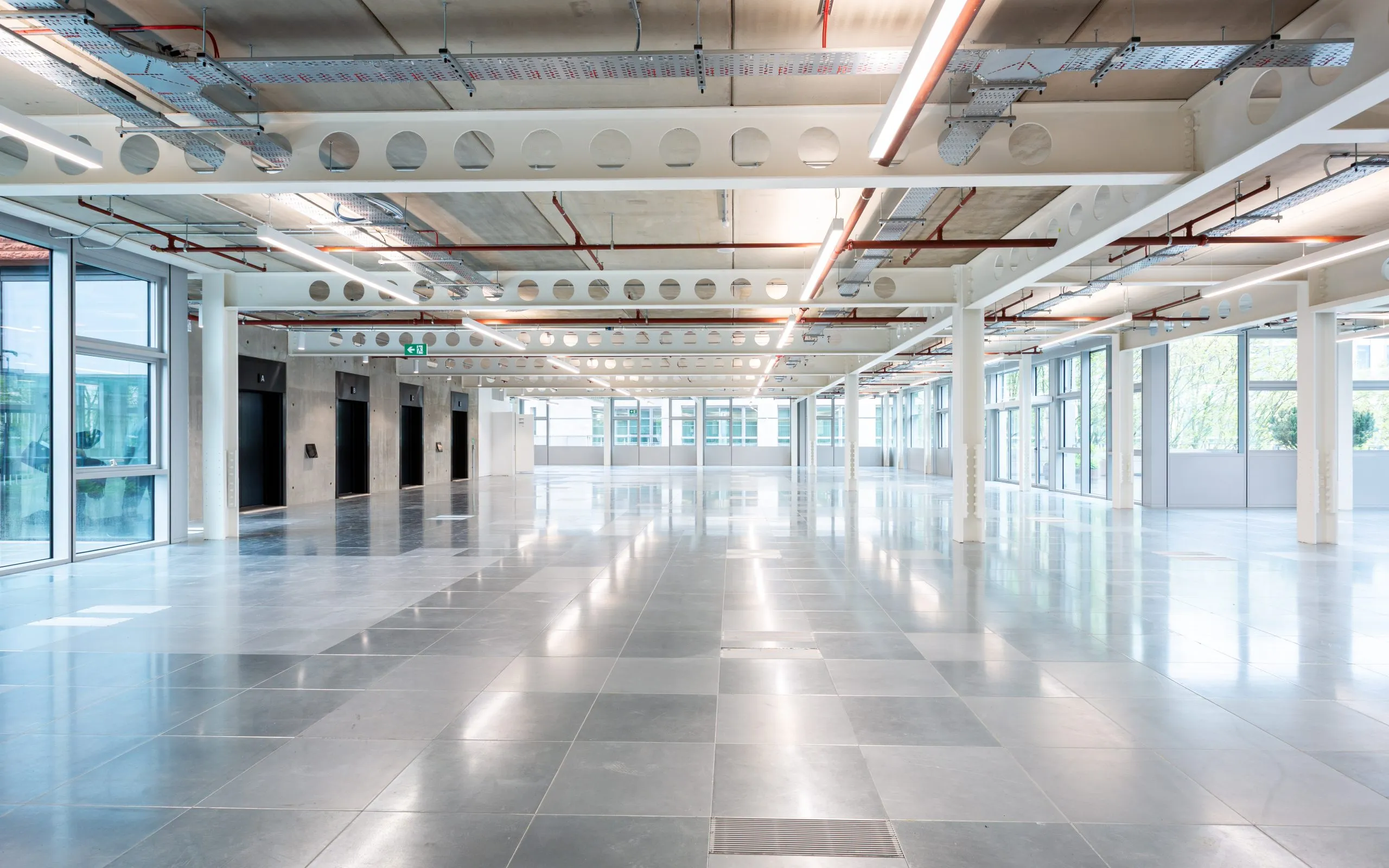
100 Fetter Lane
Alternatively, developers may choose to reinvest these efficiencies. By compressing slab-to-slab heights, UfAC can enable the construction of an additional office floor for every eight floors built, within the same overall building height – a compelling proposition in high-value urban locations where maximising net-lettable area without increasing planning mass is critical.
As Stauss adds: “Reduced floor-to-floor heights unlock real commercial value for developers. The system enables significant structural efficiencies and cost savings on new-build schemes, while installation and future reconfiguration can be completed quickly, with minimal downtime.”
Differentiation that supports rental performance
Beyond cost and carbon, UfAC contributes to product differentiation. Subtle, unobtrusive air delivery, quiet operation and improved indoor air quality enhance occupant comfort while preserving architectural intent. Combined with generous headroom and flexible layouts, these attributes help position buildings as high-performing grade-A environments, supporting stronger leasing outcomes and rental performance.
This approach is reflected in projects such as TBC.London (Tower Bridge Court), where UfAC forms part of a broader strategy to link environmental performance with commercial and social value. As developer FORE has noted, the project represents a new type of workplace environment: one designed to deliver positive outcomes across sustainability, wellbeing and long-term asset performance.
A long-term mindset for modern assets
Taken together, the evidence positions UfAC as more than a technical alternative to conventional HVAC. By reducing upfront and whole-life carbon, lowering operational energy demand, enabling more efficient building forms and supporting long-term adaptability, UfAC aligns closely with the priorities shaping today’s investment and development decisions.
In a market where future-proofing is fundamental to value, UfAC offers developers and investors a proven route to delivering buildings that perform – commercially, environmentally and over time.