Property Week News, analysis, insight and events for UK property professionals
The road ahead for the property industry remains unpredictable, a group of executives at a roundtable hosted by Property Week and Freeths last month agreed.
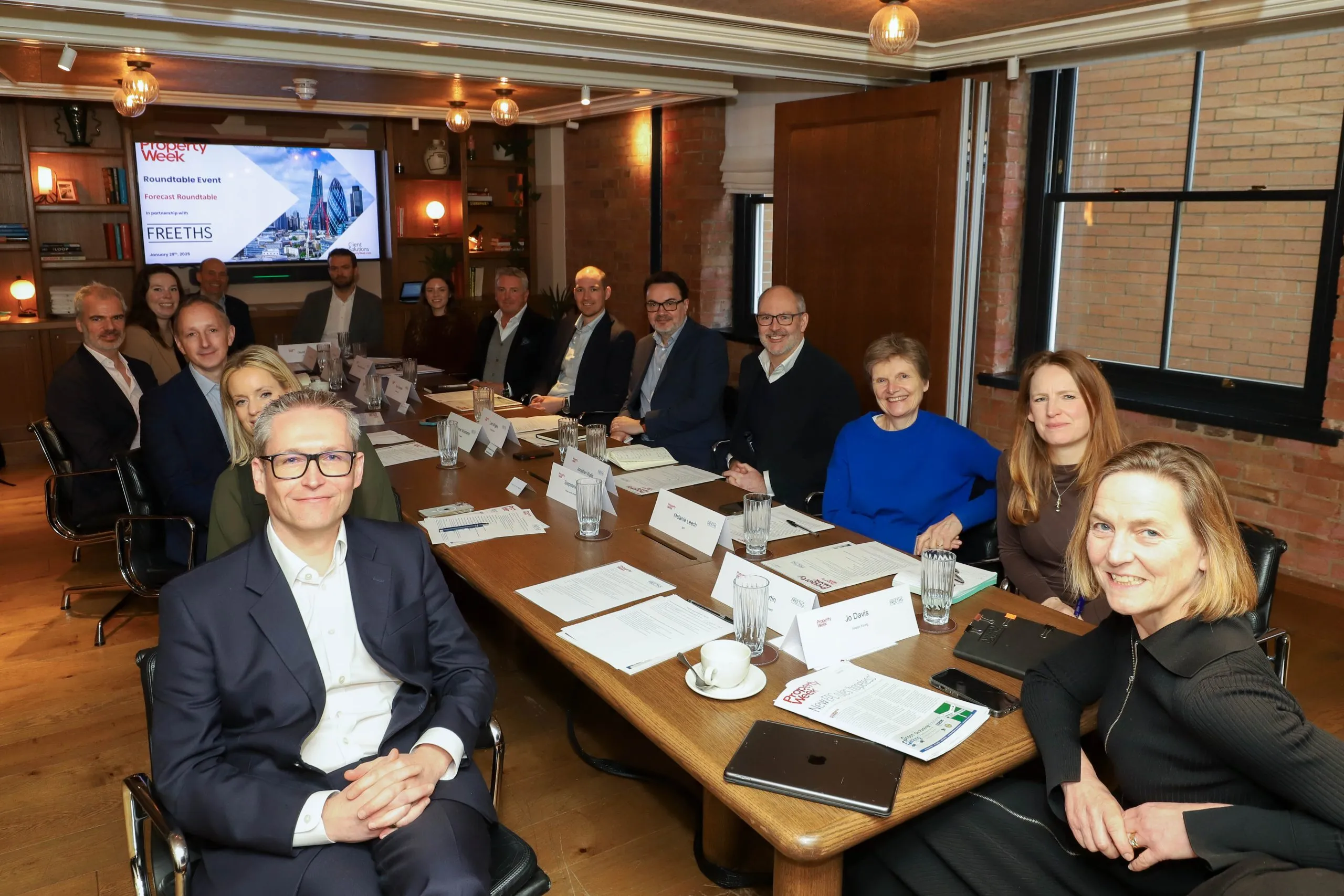
Expert panel
- Daniel Abrahams, partner, real estate, Freeths
- Emily Bastable, director, UK research, CBRE
- Matthew Bonning-Snook, chief executive, Helical
- Jo Davis, principal, UK executive chair, Avison Young
- Tom Goodall, chief executive, Related Argent
- Stephanie Hacking, real estate portfolio manager, Royal London Asset Management
- Melanie Leech, chief executive, British Property Federation
- Daniel Lovatt, director of asset management, Places for London
- Robin Martin, global head of investment strategy and research, private markets, L&G Investment Management
- Andrew Pilsworth, managing director, data centres, SEGRO
- David Prescott, deputy chief financial officer, Grainger
- Imogen Thompson, executive director, Urban Land Institute UK
- Jonathan Wallis, managing director, Tritax Big Box Developments

Daniel Abrahams

Emily Bastable

Matthew Bonning-Snook

Jo Davis

Tom Goodall

Stephanie Hacking

Melanie Leech

Daniel Lovatt

Robin Martin

Andrew Pilsworth

David Prescott

Imogen Thompson

Jonathan Wallis
Global economic and political events and the rise of artificial intelligence (AI) in business are continuing to foster uncertainty, although some recent trends are a cause for optimism.
CBRE’s latest Monthly Index analysis indicates that all commercial property capital values rose by 1.4% in 2025; and this year the firm expects to see gradual growth in capital values, driven by rising rental values rather than significant yield compression.
“We’re expecting downward pressure on inflation and we expect one interest rate cut during 2026,” said CBRE UK research director Emily Bastable. “In the investment market, there are already signs of positive momentum, which we expect to continue throughout the year. Our figures indicate UK investment volumes of more than £62bn in 2025, which represents the highest annual total since 2018. The Q4 volume totalled £26bn-plus, marking an uptick in large transactions relative to earlier in the year.”
Those headline figures chimed with the experience of Freeths’ real estate partner Daniel Abrahams. “Our own international clients tell us they’re refocusing on the UK, and capital remains available for deals with solid fundamentals,” he said. “While some global headwinds remain, the UK’s transparent legal framework and robust governance continue to make it an attractive environment for both domestic and international investors.”
Bringing a fund management perspective, Stephanie Hacking, real estate portfolio manager at Royal London Asset Management, said her expectations for returns and performance this year remained the same as for 2025.
People can’t continue to put things on hold because of uncertainty – because uncertainty is the norm
Jonathan Wallis, Tritax Big Box
“In the commercial sector, the central London office development pipeline is pretty much non-existent in core markets, which is creating good market fundamentals for positive returns driven by strong rental growth,” she said. “We’ve seen the same dynamics within industrial markets with reversionary potential driven by restricted supply and good, stable demand.”
Hacking added that socio-demographic trends would also buoy healthcare and build-to-rent (BTR) assets. “We’re seeing a lot of investor flow in that direction driven by needs-based demand,” said Hacking. “Supply of institutional-quality BTR and healthcare [assets] is constrained, impacted by viability and planning challenges. We now have a planning framework that is hopefully going to be positive to help release some of those sites.
“The issues around construction inflation have impacted development pipelines across all sectors, with inflationary pressures becoming more muted. Going forward, we can’t see anything that’s going to be materially different from those fundamentals, and our forecasts haven’t materially moved compared with last year.”
Positive start
Hacking’s positive view of the industrial and logistics market was shared by Jonathan Wallis, managing director of Tritax Big Box Developments, who said there had been a surge in enquiries and viewings following the November Budget.
“People just wanted to get on with life,” he said. “Since the Budget, we’ve seen a 15% increase in enquiries compared with the same period last year, and a 55% increase in pre-let discussions compared with 12 months ago. We’ve got £8.9m worth of development lettings currently in solicitors’ hands.
“So in terms of a start to the year, we’re very positive. People can’t continue to put things on hold because of uncertainty – because uncertainty is [now] the norm.”
Imogen Thompson, executive director of the Urban Land Institute (ULI) in the UK, said ULI members had expressed similar sentiments.
“No one is emphatically saying that this year is going to be dire or that it’s going to be gangbusters; but I think what we need to acknowledge is that there’s still a huge element of uncertainty in the room,” she said.
“Even if we fix the macroeconomic factors that are playing into the investment decisions being made, there are still all these policy hurdles that need to be overcome. From a European standpoint, we see people accepting that uncertainty is now normal and we just need to get on with it. What that looks like remains to be seen.
“Sentiment is not cautiously optimistic so much as ‘we can’t have another year of nothing, and we don’t want to be negative about it, but let’s not get our hopes up either’.”
From a listed propco perspective, that uncertainty looks rather different. David Prescott, deputy chief financial officer at Grainger, said: “In a daily traded real estate business, you can see there’s a huge amount of uncertainty already priced in, with businesses trading at significant discounts [to net asset values].”
Prescott said the outlook for 2026 “depends if you’re looking at a listed or direct market”, adding: “In a listed space, I probably am very optimistic. I can’t see how there can be more uncertainty priced into that space.”
Regulatory reform
UK regulatory and planning reform is inevitably expected to play a major role in shaping the year. Tom Goodall, chief executive of Related Argent, said he welcomed the growing recognition within government that systemic change is needed to deliver economic growth.
Goodall pointed to the overhaul now under way at the Building Safety Regulator (BSR), following the appointment last July of former London Fire Brigade commissioner Andy Roe as chair. “His honesty and humility immediately changed the tune of how the private sector felt about engaging with the regulator,” he said.
However, Goodall argued that the BSR’s statutory aim of 12 weeks from submission to sign-off was still too long, particularly when assessing the internal rate of return (IRR) on capital sunk into a project.
“It takes at least four months to prepare the information, so you’re adding seven or eight months,” Goodall explained. “In an IRR-based investment world, that is very, very damaging. It’s effectively the affordable housing just evaporating, in a viability sense.”
 Jo Davis, principal and UK executive chair at Avison Young, said she felt the industry had been strengthened, from a planning perspective at least, following the significant revisions made to the National Planning Policy Framework (NPPF) in December 2024.
These included the reinstatement of mandatory housing targets for local councils and the addition of a ‘grey-belt’ land definition.
“The scale of applications that started to go in following the changes to the NPPF means we should see the results trickling into 2026,” Davis said. “The viability piece doesn’t go away, but the foundations or roots feel like they’re strengthening.”
Further revisions to the NPPF were proposed in December 2025, including a new approach to viability assessment. The industry has until 10 March to respond.
Most participants felt AI was likely to have a significant influence across the property industry in the year ahead.
Andrew Pilsworth, managing director for data centres at SEGRO, said industrial and logistics specialists would continue to benefit from the global trend in AI adoption and massive growth in demand for cloud storage. “That’s what really drives the demand for our end customers, the big tech giants,” he said. “So it’s more of a global phenomenon that we’re looking at, and a smaller number of very big deals in key locations, rather than large quantities of leasing opportunities.”
Helical chief executive Matthew Bonning-Snook said he suspected that office markets on the periphery of London – such as Stratford and Croydon – would suffer “quite hugely” as a result of growing AI adoption. These non-core locations tend to house back-office functions, where AI is expected to fuel substantial headcount reductions.
Impact of AI
By contrast, in central London, many occupiers are looking to expand. “One US law firm we are talking to is aiming to grow from about 90,000 sq ft to 150,000 sq ft, and is expecting to be much, much bigger in five to 10 years,” Bonning-Snook said. “They are clearly not expecting AI to lead to a massive restricting of their headcount.”
He added that Helical is also familiar with the changing needs of AI and tech providers through its Old Street assets. “The AI businesses and some of the tech businesses that we have there are growing exponentially because the software they are producing is much better because of AI,” he said. “It feels to me as though people will become a lot more productive on the back of AI; they’re giving a lot of the mundane tasks of their job to AI.
“A lot of the young people in our office, and I’m sure every other office, are embracing AI and seeing it not as an enemy that’s going to take their job away, but something that’s going to make them more productive.
“So I think there’s going to be a lot of benefit, but it will also mean the best product in central London is probably going to be more valuable and there will be other office space that will greatly suffer as a result.”
The impact of local elections due in May – some of which have been postponed – plus national elections in Scotland and Wales also loomed large in the discussion. In particular, concerns were raised about potential delays to planning and funding decisions.
Goodall said: “In the last week, some of our public sector partners have effectively said ‘if you want a decision before July, you need it in the next board cycle’, which means you need it in the next three weeks. The economic outlook for the sector will surely be impacted by the fact that, in most cases, there’s some kind of public sector partner or decision-making involved and they will be frozen in terms of decision-making.”
Ongoing delays
Daniel Lovatt, director of asset management at Places for London, Transport for London’s property company, also expressed fears about looming delays. “We need some major infrastructure frameworks to make these projects work within a sensible time,” he said.
Lovatt said that Places for London was now looking forward to the redevelopment of South Kensington station, but that the development process had taken far too long. “We’re planning to start public consultation on two of our major commercial projects this summer,” he said, expressing concern about the length of the full approval process. “You want to sit down and talk to international investors, to get some certainty around these projects, and you can’t really articulate a sensible timeframe for an investor to be involved.”
He added: “I think that’s causing us a real problem. We’ve had a difficult operating environment over the last two years, so I think we need to get our optimism back.”
According to British Property Federation chief executive Melanie Leech, it is not only the disruptive process of having an election that affects the industry, but also the uncertainty about “what kind of make-up of local authority you’re going to be dealing with afterwards, because it’s so unpredictable”.
She added: “There may be no majority, the majority may be very unexpected and councillors may be inexperienced and totally unused to dealing with the kind of issues they will come across.”
By contrast, Robin Martin, global head of investment strategy and research at L&G Investment Management, observed that the UK may benefit from political instability elsewhere.
“Politics is becoming more febrile, more volatile everywhere,” he said. “I don’t think anyone is sitting looking at 2026 and saying ‘it’s all clear’. It’s complicated everywhere, [but] if we think about multinational capital, mobile capital, a lot more investors are looking at the UK.”
Martin explained: “A lot of asset owners will bucket the global regions into the Americas, into Europe and into APAC, and a lot of capital is looking at Europe. And the UK is part of that in a way that it hasn’t been for the last few years.”