 Property Week News, analysis, insight and events for UK property professionals
Many people living in new housing developments may be aware of how reliant they are on a car. Some might be thinking about congestion or transport emissions, or even how emissions can affect their physical and mental health. But once these housing developments have been built, very little can be done to change the underlying conditions that make places car dependent.

Ed Parham
It has proved challenging for developers to predict the transport emissions of future residents, because emissions arise from travel behaviour that is a result of many individuals’ choices about where they go and how they get there. But a new raft of pioneering spatial modelling and analysis tools is changing this – and creating opportunities for developers that can understand these behaviours.
Decades of spatial modelling and research means we now understand how the design of the built environment works across many scales to make certain travel behaviour more or less likely. Essentially, the location of a site – how it is embedded in a surrounding town or city and wider region – along with its local street layout, mix of uses and densities, leads to the creation of places that can be either car dependent or walkable and active.
We can now create models combining hundreds of thousands of inputs on location, place and access to public transport with demographic and socioeconomic data. These models can calculate the share of how different people get to work and how far they travel for every census area boundary in the country.
The results can be visualised in a transport carbon intensity map, showing the emissions, high or low, associated with sites, as well as used in a predictive model to compare the impact of adding additional housing to specific locations.
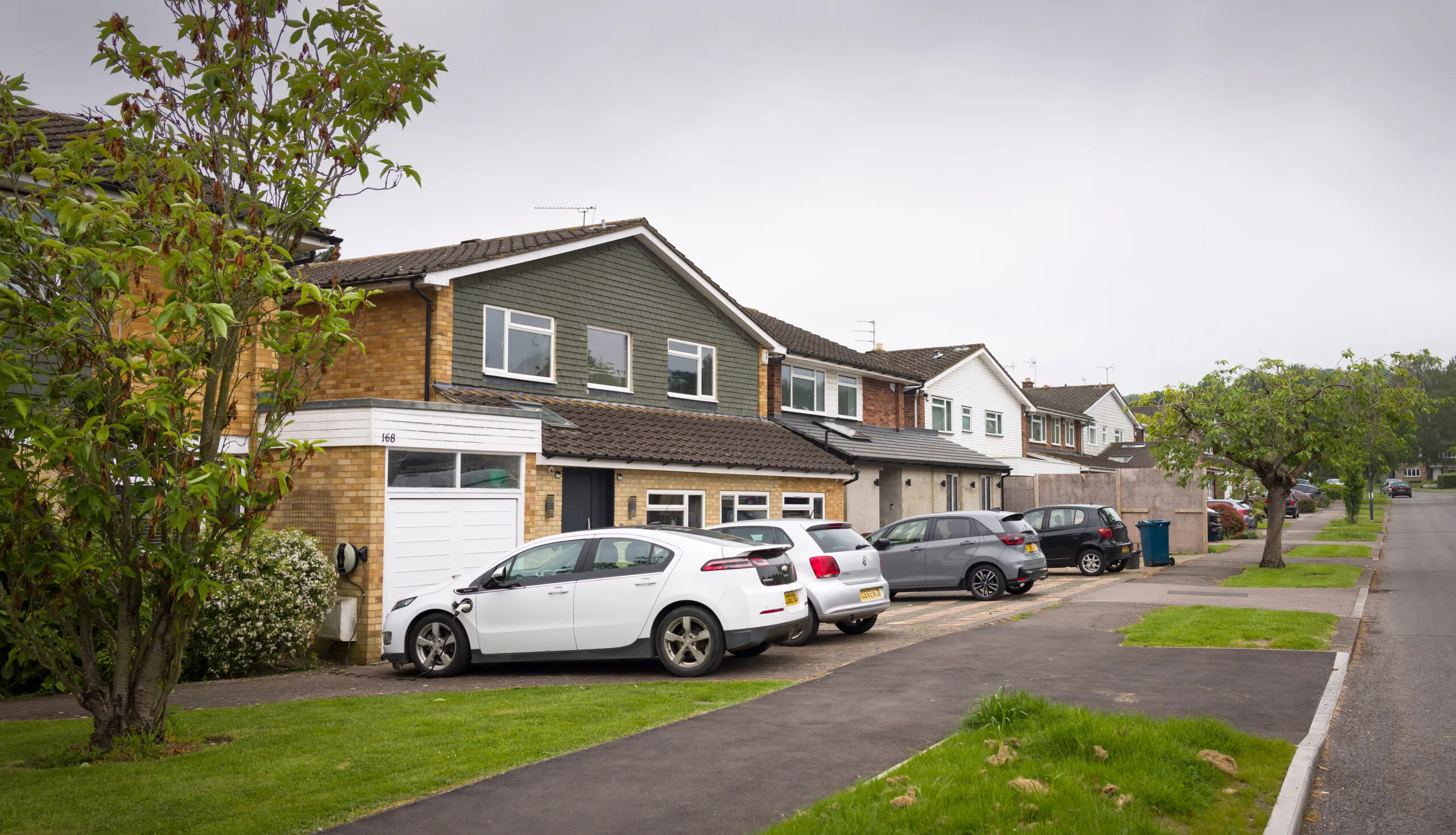
Roadblock: many housing developments are highly car dependent. Credit: Shutterstock/ Paul Maguire
The use of such tools in the planning process can be hugely beneficial for developers as well as the public sector. The latter gains more robust tools to assess proposed development, helping to balance the need to build more housing with the need to meet climate targets. But it also brings opportunities for private sector stakeholders – housebuilders, investors and shareholders – to benefit.
By profiling and ranking locations according to their transport carbon figure, the most suitable sites can be identified before they are acquired. For investors with an ESG responsibility, this analysis can demonstrate how their planned investments, or existing portfolios, are in as sustainable locations as possible. It also has potential applications for carbon reporting.
Later in the process, as a design begins to take shape, the lessons from analysis can be turned into a set of design principles and, ultimately, a brief. More people are active in places that are mixed use, compact and connected. These sorts of places also generate higher property values. The implication of this is that development needs to create genuine urbanism, composed of more than just housing.
Developers can use such measurable design characteristics to set a performance target, while still allowing designers the flexibility and freedom to operate. One example would be achieving a target number of homes on a particular site by accommodating them in a proposal that achieves a minimum walkability index score. Use of these techniques not only creates better longer-term outcomes, it can also provide evidence to help support a scheme through the planning process.
Another benefit is that a site’s limitations can not only be seen but clearly understood. Once the limitations of a car-dependent location have been identified, they can be mitigated, perhaps by diversifying the mix of uses, providing housing with work-from-home capabilities or ensuring that shared electric car facilities are embedded in the design of a development.
By understanding the transport carbon impacts of specific location choices, developers and housebuilders can target their land acquisitions to sites with higher underlying value. They can also strengthen the case for development and increase the likelihood of a successful planning application.
Investors and shareholders can be satisfied that they are supporting responsible schemes that are more likely to create positive long-term outcomes. And local authorities, for their part, can more easily balance housing growth requirements with climate targets.
Ed Parham is director of innovation at Space Syntax