 Property Week News, analysis, insight and events for UK property professionals
Much has been said in recent years about the expensive and time-consuming planning process for warehouses in England.

In the zone: Slough Trading Estate is one of only two operational SPZs in England
In some parts of the country, it can take up to two years to achieve consent, by which time developments may no longer be financially viable.
However, there exists an under-utilised statutory planning tool that, in theory, can reduce the planning process to zero days. The Town and Country Planning Act 1990 includes the provision of Simplified Planning Zones (SPZs), which can turn planning from an arduous battle with local authorities into a flexible and agile partnership. But only if strict criteria are met.
There are just two operational SPZs in England: Slough Trading Estate in Berkshire and Kings Norton Business Centre in Birmingham. Both sites are predominantly industrial estates.
For more than 30 years, development at the SEGRO-owned estate in Slough has been determined by successive 10-year agreements with Slough Borough Council, the last of which was ratified last year (see box). Working together, SEGRO and the council have agreed a decade-long masterplan that spans design codes, building heights and locations and associated Section 106 (S106) contributions.
Anna Bond, head of the western corridor at SEGRO, says: “The SPZ gives us certainty and, crucially, it also gives us speed.” She adds: “It means we can react quickly to market conditions, whereas other developers would be bogged down in the planning process, which, depending on the authority, can add 18 to 24 months to delivery timescales.”
Obtaining an SPZ is expensive, particularly if it’s for smaller-scale development
Robert Bruce, Freeths
The effectiveness of the SPZ can be seen in SEGRO’s recent redevelopment of 136 Edinburgh Avenue at the Slough site. The developer has replaced a single large building with nine energy-efficient units, which have achieved BREEAM ‘Excellent’ and EPC ‘A+’ ratings.
“Rather than going through a two-year planning period for this scheme, we were able to submit a notice to the council and within three weeks we were able to start on site,” says Bond.
The process could be even quicker. Submission of notice is not a statutory requirement, but an additional step SEGRO takes to ensure the council agrees it has correctly interpreted the SPZ.
Unsurprisingly, securing a 10-year planning agreement is far from straightforward. “It’s a huge amount of work,” says Bond. “For the latest SPZ, we ran a large number of workshops and did lots of engagement with the local community.
“On top of that, it is quite expensive. Some of the S106 contributions are directly related to what you build, but there are other things within the S106 that you have to do, regardless of whether you do any development. And because of those costs and the workload, an SPZ is only worthwhile if you’re going to do a significant amount of development.”

Built for business: SEGRO’s newly refurbished 136 Edinburgh Avenue in Slough
The upfront delivery of S106 elements is part of what makes an SPZ so appealing to a planning authority. Rather than having to wait for delivery, the council can immediately factor in the additional resources. Councillor Paul Kelly, lead member for housing, highways, planning and transport at Slough Borough Council, says the money raised from S106 contributions at the estate will be invested in areas that make “a real difference to the residents of Slough”, such as skills and training and sustainable transport.
In total, SEGRO will pay more than £20m in S106 contributions over the course of the 10-year period. Raoul Veevers, UK head of planning at agency JLL, believes that total outlay represents good value. “It’s a very good deal for SEGRO, despite being significantly more money than their previous agreement,” he says.
Win-win arrangement
Veevers adds: “In terms of the infrastructure costs, and all the other S106 requirements that you would normally get from a development, it’s definitely more cost-effective and efficient than piece-by-piece development, and it also benefits the council, which gets certainty over the funds it can use to improve the area.”
England’s other active SPZ site is owned by HEREF Merlin Kings Norton. The initial SPZ for Kings Norton Business Centre was granted in 1998 and the latest 10-year agreement for the 58-acre site will run until 2027. HEREF could not be reached for comment.
Near Rochdale, the Heywood Distribution Park SPZ was adopted in 2010 but was not extended post-2020. There has been greater appetite for SPZs in Scotland, including wide use of the tool to assist town centre rejuvenation and high street vacancy rates, such as in Renfrew.
However, SPZs remain largely unpopular in England. The biggest stumbling block remains land ownership and planning authorities’ unwillingness to cede control to developers.
“They [SPZs] can only really work for sites in single ownership – that is the crucial element,” explains Bond. “On top of that, it also needs to be a fragmented site, with lots of buildings of different ages and multiple development plots coming through at different times. If you are just going to knock it all down and build one mega-shed, it would be cheaper to go for standard planning.”
Veevers says it is rare for a location to satisfy all the necessary requirements that make an SPZ workable. “You have got to have a willing landowner and there are very few locations that have significant single landowners where both the landowner and local authority are aligned in attracting investment and also where there is a churn on occupiers,” he adds.
Sheridan Treger, senior associate at law firm Bryan Cave Leighton Paisner, says SPZs are among a range of statutory tools that have been “left on the legislative shelf” as planning authorities tend to shy away from giving up total control. “Local authorities are reluctant to relinquish their discretionary planning controls to a form of zoning, which failed to gain traction on an England-wide basis under the last government exactly because of deep political opposition at the local level,” he says.
The SPZ gives us certainty and, crucially, it also gives us speed
Anna Bond, SEGRO
“At the very least, you’d have thought SPZs could be fantastic as a vehicle not just for easing up the planning regime on a couple of business parks on previously developed land – their current limited usage – but for making the government’s industrial strategy happen in a big way: clusters of data centres, gigafactories and biotech labs in collaboration with major site owners.”
Fergus Charlton, planning partner at law firm Michelmores, agrees that councils are the major stumbling block. “Authorities are typically wary of ceding their ability to control,” he says. “The lack of a planning application for determination accordingly makes them nervous of SPZs.”
Familiarity breeds favourability
Another key factor in the lack of uptake is unfamiliarity with the process of adopting an SPZ. “As is the case with the application of compulsory purchase powers, many resource-stretched authorities will place SPZs in the ‘too difficult’ tray without considering what is involved in the process or what the benefits to growth and regeneration might actually be,” says Charlton.
Robert Bruce, planning partner at law firm Freeths, says the complicated technical requirements of agreeing an SPZ are exacerbated by the limitations of where they can be used. “There are exclusions on their use limiting their usefulness, including on protected areas such as conservation areas, green belt, Sites of Special Scientific Interest and Environmental Impact Assessment [EIA] development requiring an environmental statement,” he explains.
“The large majority of developments at scale would constitute EIA development and obtaining an SPZ is an expensive exercise, particularly if it’s for smaller-scale development.”
While the active SPZs in Slough and Birmingham are considered successes, Charlton says there is little prospect of further SPZs coming into force as planners often prefer SPZs’ Town and Country Planning Act ‘stablemate’ local development orders (LDOs), which offer similar functions. He says LDOs are considered more flexible and applicable to a wide variety of sites and development types.
“With the statutory mechanism to create LDOs and SPZs being similar, and the outcomes likewise similar, the balance in favour of the LDOs over SPZs may turn on inclusion in the latter of the term ‘zone’, which is perhaps ‘too European a concept’ for the English planning system,” Charlton adds. “The dominance of LDOs over SPZs will continue as they are actively encouraged by national planning policy.”
So, while SPZs might help warehouse developers in some circumstances, they are not a silver bullet. Developers will have to hope the government’s planning reforms deliver a faster and more cost-effective system.
Slough’s simple system
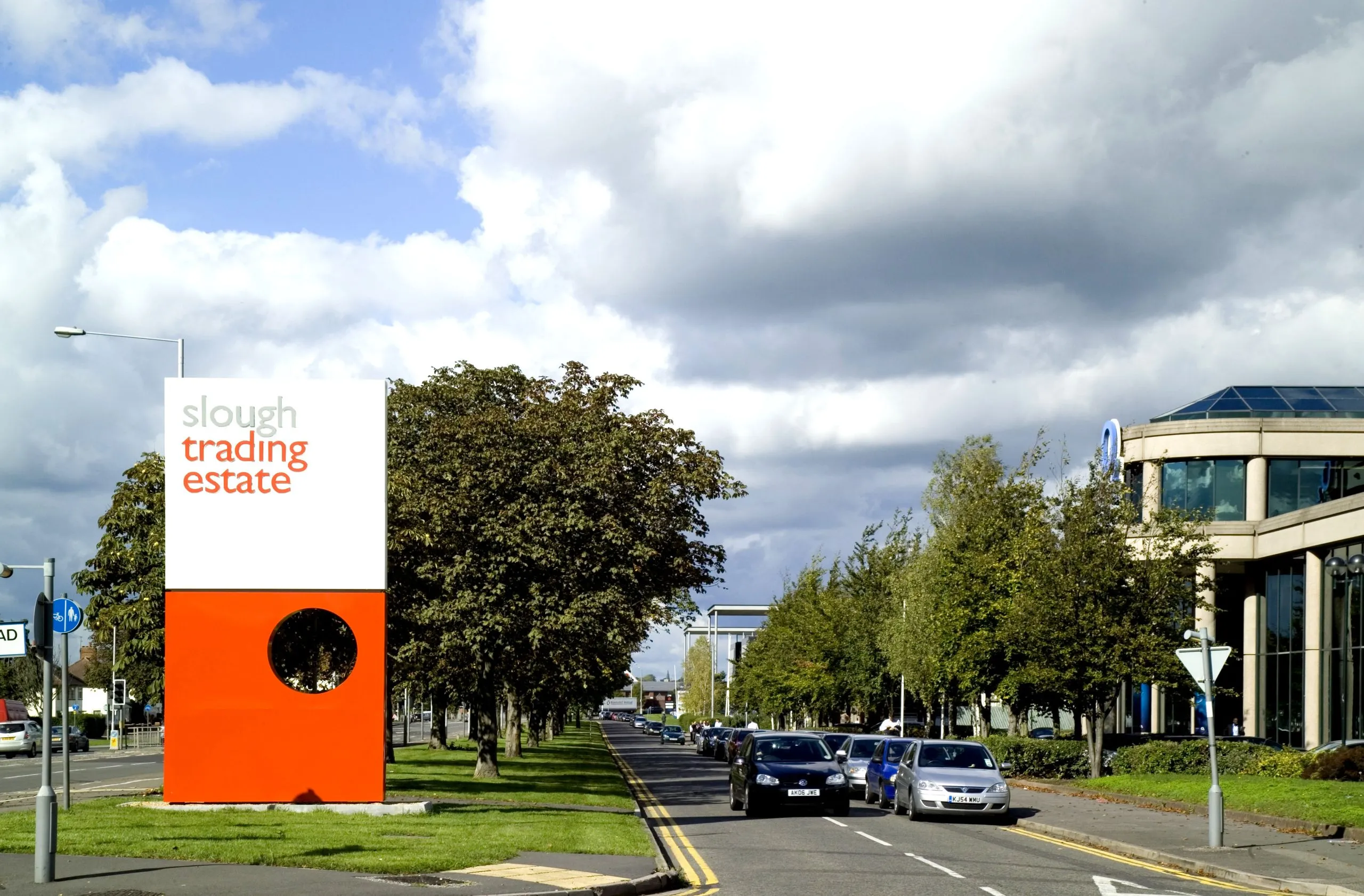
Slough Trading Estate, Signs
Slough Trading Estate has a total leasable area of more than 6.5m sq ft across 456 units. The first edition of the SPZ was introduced in 1994 and the fourth version runs from 2024 to 2034.
The SPZ grants permission for general industrial, storage, distribution and data centres to a maximum height of 38m (125ft) (dependent on location). It also permits a broad range of commercial uses and certain other developments limited to some retail, financial and professional services and hot food takeaway.
Under the terms of the SPZ extensions, solar panels, demolition, decked car parking and refurbishment are all permissible.
The agreement includes a mandatory design code that covers both the buildings and landscaping that all new development must adhere to.
S106 contributions that SEGRO has agreed so far include paying £4.3m to create a new bus route and making a further £4.3m payment towards highway improvements. It has also agreed to contribute £2m for skills, education and training, and £1m for landscape and biodiversity improvements and maintenance.