 Property Week News, analysis, insight and events for UK property professionals
Walking around New York’s Rockefeller Center, the huge 1930s complex comprising 19 buildings and 17m sq ft of office space on a 9ha site, I felt a disorienting mix of awe and recognition.

Félicie Krikler is director, head of residential, at Barr Gazetas
As an architect, I had studied its photographs, plans and place in architectural history. Yet walking through its plazas, arcades and buildings, I saw that it is not just a study in Art Deco urbanism; it is a lived environment, one that drew my admiration along with reflections on urban curation. It is a great example of long-term stewardship, branding and the enduring power of place.
My first impression was undeniably aesthetic: the Rockefeller Center is the world’s largest privately funded Art Deco project and its visual coherence still astonishes. Unlike many inter-war developments, the ensemble reads as a single architectural vision. The limestone facades, the setbacks of the Comcast tower and the rhythm of verticals and horizontals all combine into a unified sculptural composition.
In London, we often point to Dolphin Square, Broadcasting House and the Daily Express Building as our Art Deco icons; but compared with the Rockefeller Center, even these feel modest. It is a city-making exercise, an entire district designed in one stylistic breath. The scale alone is moving; but more than that, it is the confidence with which the original architecture, landscape and public art are woven together, all down to the smallest internal details, that impresses as co-ordinated and controlled.
The urban intelligence of the complex revealed itself as I entered through the Channel Gardens from Fifth Avenue. Shops, restaurants, arcades and underground concourses give the place the feel of a miniature city within the city. The famous sunken plaza is a brilliant manipulation of levels, creating a layered urban stage where people can gather above, beside and below the central axis.
The Rockefeller Center pioneered what we now call ‘estate thinking’: a holistic approach where commercial offices are inseparable from retail, leisure and public space. In London, developments such as Broadgate and Canary Wharf have taken similar lessons on board, but the Rockefeller Center feels different. Unlike more sterile business districts, it hums with life at all hours, precisely because it was designed to do so.
The art of placemaking
Even more striking than the buildings is the art: Paul Manship’s gilded Prometheus sculpture, gleaming against the water of the plaza fountain, and Lee Lawrie’s monumental Atlas statue facing Fifth Avenue. They are not afterthoughts; they are integral to the spatial drama. They reminded me of the close bond between place, architecture and culture. As well as tenant mix and design codes, placemaking is about using art and culture to create an emotional connection with a place, differentiating an estate from its competitors. This is a brilliant example.
The cultural symbolism of the place is grounding and, despite the Rockefeller Center’s gigantic scale, there is also something incredibly human that still embodies 1930s American optimism.
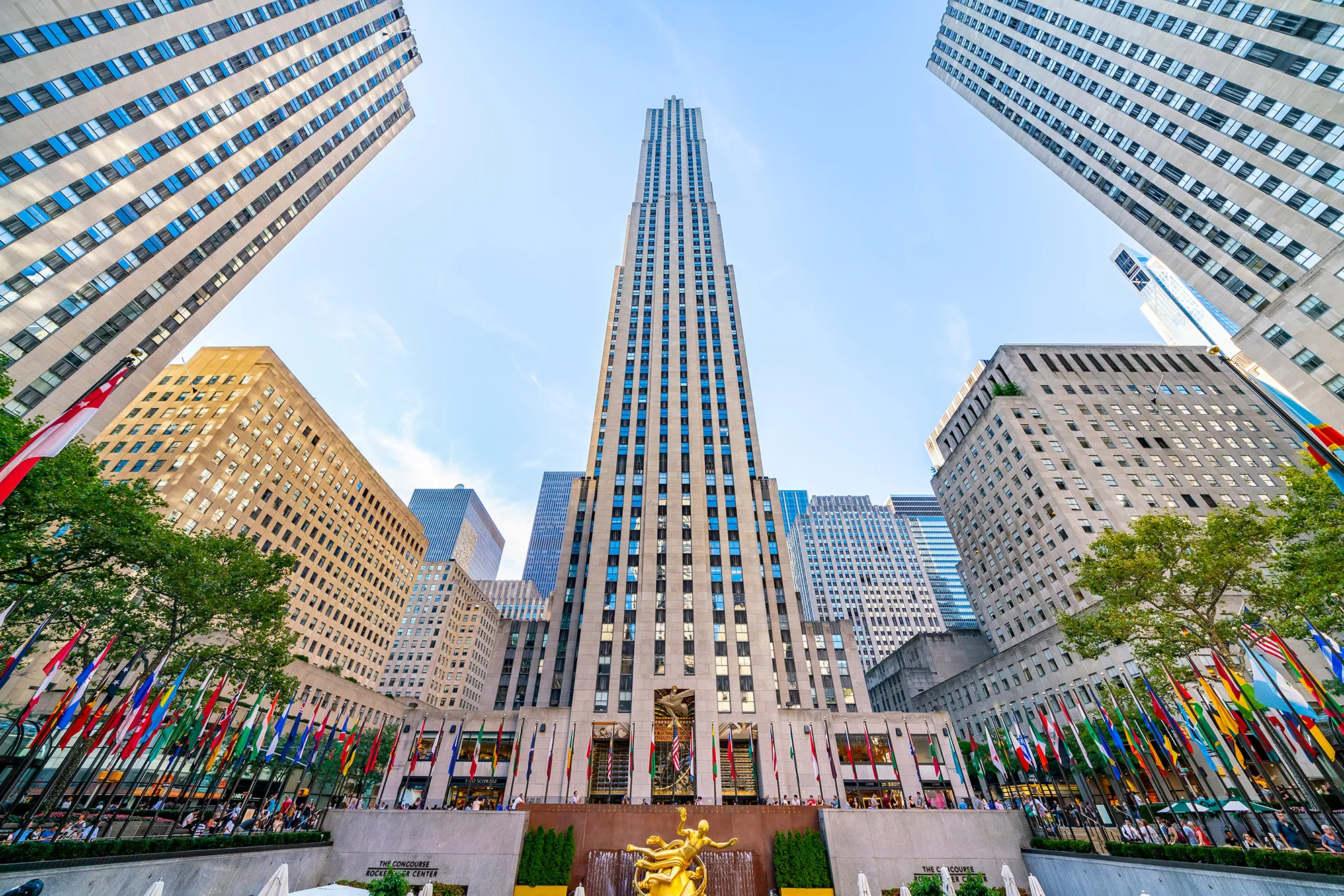
Architectural awe: New York’s Rockefeller Center achieves visual coherence
Architectural critic and historian Lewis Mumford initially derided the Rockefeller Center as “reckless, romantic chaos”, yet by the 1940s he admitted its coherence and even praised its human scale compared with later mega-projects. I agree with his later assessment: the monumentality does not dwarf the visitor. The plazas invite you in; the setbacks guide your eye upward without crushing you. It achieves that elusive quality of intimacy at scale.
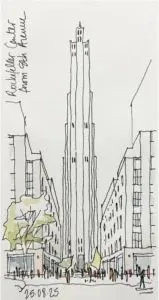
First impressions: Félicie Krikler’s sketch of the Rockefeller Center
I also saw the ongoing reinvention that keeps the Rockefeller Center relevant. It is not stuck in the past; rooftop terraces have been opened to the public, offering new perspectives on the city. Retail and dining have been sensitively reimagined without erasing the complex’s Art Deco character. It demonstrates that stewardship through reinvesting, curating and opening up to new audiences can extend vitality across generations.
As I left, I felt admiration but also a sense of provocation. What does it mean, as an architect and someone working in property, to aspire to projects of such scale and ambition today? I was deeply moved by what I saw, yet also unsettled by my own emotional response.
My instinct as a designer is to seek variety, contrast and human scale and to look to foster community through inclusive and collaborative design – an ethos I had assumed to be at odds with this grand civic vision. Perhaps it is a powerful reminder of the words of writer Jane Jacobs: “Grand plans succeed only when they nourish the small-scale rhythms of everyday life.”
Félicie Krikler is director, head of residential, at Barr Gazetas