 Property Week News, analysis, insight and events for UK property professionals
As Property Week and Freeths’ latest Power of Proptech survey reveals, the role of technology in the property sector is accelerating fast.
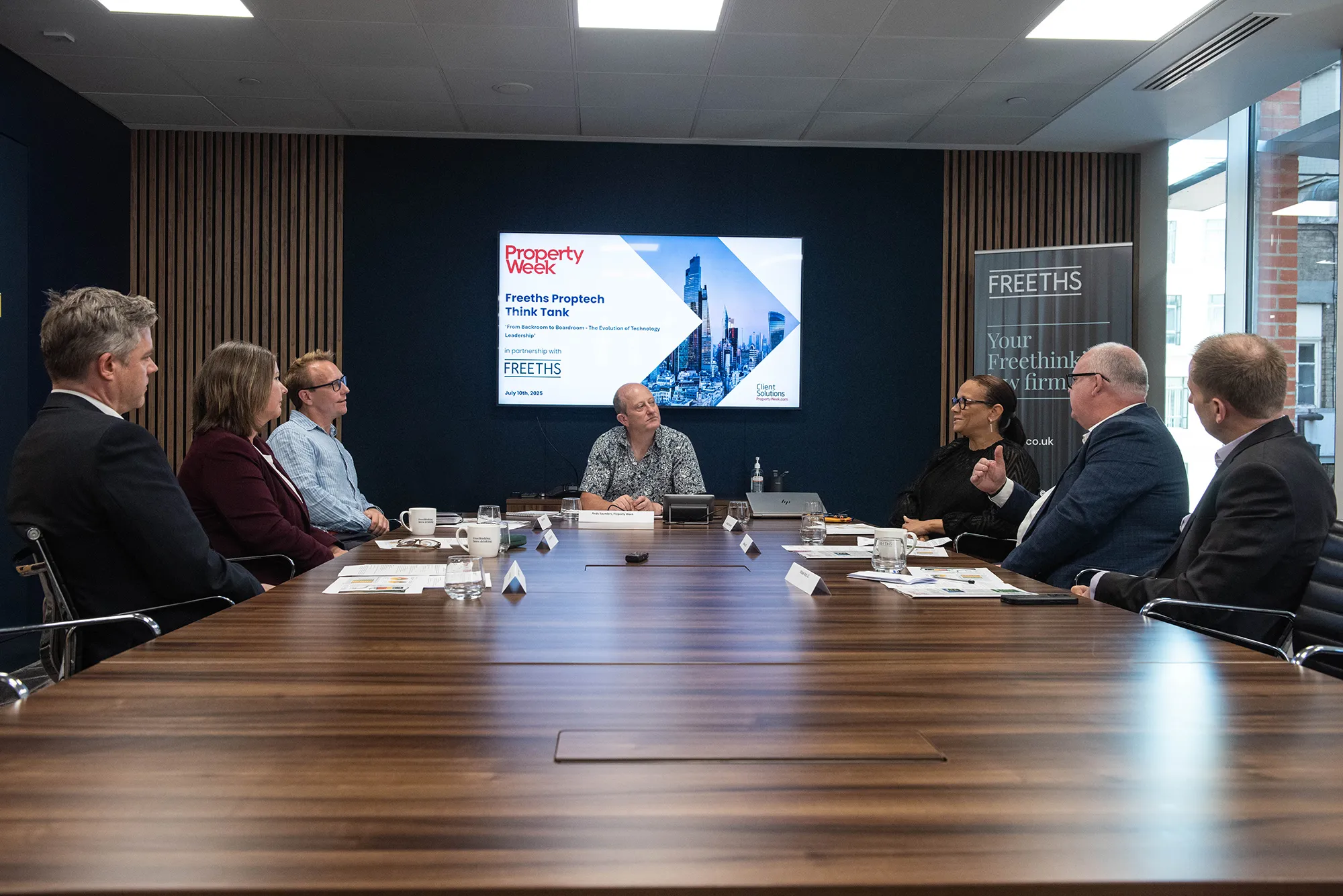
Expert panel
- Clive Pearce, partner, Freeths
- Michael Aston, head of technology delivery, JLL
- Rupert Dean, co-founder and chief executive, x+why
- Neil Milburn, director product and innovation, SEGRO
- Linda Morant, chief digital officer, The Crown Estate
- Jenny Obee, information and digital technology director – Related Argent

Clive Pearce

Michael Aston

Rupert Dean

Neil Milburn

Linda Morant

Jenny Obee
No less than 85% of respondents were either much more or a little more confident of the value of artificial intelligence (AI) to their business than they were last year.
But translating this confidence into real business advantages calls for leadership that is as agile, capable and fast-moving as technology itself. Where are the latest technologies showing the strongest results? What kind of impact is AI in particular having on businesses – and leaders – in the sector? How are board roles and governance changing as technology becomes ever-more pervasive?
To examine these issues around the changing face of technology leadership, Property Week in conjunction with Freeths, which was recently crowned Law Firm of the Year at the Property Awards, invited a select panel of industry experts to share their thoughts, insights and experience on the question of whether proptech really has moved from the backroom to the boardroom.
In the latest Power of Proptech survey, 59% said that proptech was a high priority in improving business profitability, but 49% also said they had yet to appoint a chief technology officer (CTO). Does technology need a stronger presence in the boardroom, and should that presence be in the shape of a CTO?
Linda Morant: I do think that there is a need for a technology voice in the boardroom, but the conversation around technology is very different at the board level. It is not about what technology is being built, but about how it is being used and what the results are. If AI, for example, is being used on the financial side, how is that AI capability being governed? I am looking at it from a risk perspective, not from the pure technology perspective.
At The Crown Estate, we have made a committed effort to really build up the board’s knowledge around technology. I don’t need the board to be technologists, but I do need them to understand it enough to make governance decisions where technology is being delivered.
Jenny Obee: Technology does need a strong voice in the boardroom, but I don’t personally think it has to be someone in a CTO or chief information officer [CIO] role – so long as you have that strong voice and the means to escalate and report in on a board level when you need to.
Michael Aston: The opportunity that having a CTO creates is for technology transformation. Any effective organisation is going to have technology embedded in it, and that naturally creates evolution – how do we do what we already do better and smarter?
But if you want to really transform your business, you need someone at a strategic level who understands technology in a more holistic way. So you can ask: “What if we did things differently? What if we stopped doing this and started doing that instead?” You won’t get that from technology that is embedded in your business; it needs to be a leadership role.
Clive Pearce: At a strategic level, we have a director of technology and innovation who reports directly to the board. So the board here is involved not only in strategic planning for how new tech will be deployed, but also in how those deployed technologies will be integrated and used, because they are only as good as the people trying to use them.
What you want to do as you become a more mature business is to reflect on a more strategic review of the benefits that technology could bring
Rupert Dean, x+why
So there are a lot of educational elements, and that is where having a CTO or CIO or someone reporting to the board really comes into its own.
Neil Milburn: We have been increasing our investment in technology and we have also recently recruited a new CIO. He reports in to an exec member but he is spending a lot of time with the board and the exec team talking about technology.
Rupert Dean: Doesn’t it depend to a degree on the size and nature of the company itself? A company with very tech-focused product, or a large services company, is probably going to have a tech person [on the board].
For me personally, x+why is a very human-centric company and we spend a lot of time building our community – I’ll always put that first. I don’t think our business model at the moment requires tech to have a stronger voice in the boardroom, although I am always slightly nervous about the things I don’t know.
Is it more important to have tech skills in the team or at the top leadership level?
NM: We are investing heavily in educating everyone in the business about new technology, because everyone is having to grapple with it arriving at a rapid pace. I am a chartered surveyor by background, but I am the leader of our digital team – we have all had to step up. Our approach is very much that digital needs to be integral to the business. It is not a separate entity that sits in a backroom.
LM: I think you need both – all over skills. And Neil’s point [about education] is absolutely correct. We have rolled out apprenticeship programs for AI. We have rolled out company-wide training. We have also rolled out senior leadership training, an AI governance committee and an AI hotline. Technology is now one of the criteria we vet board members against.
RD: Most of the businesses in our sector are very young and quite human-centric, so we spend a lot of time dealing with people and with emotions. What you want to do as you become a more mature business is to reflect on a more strategic review of the benefits that technology could bring. Because so much of what we do is look at specific areas of the business that can be improved; whereas what you need is to take a more holistic view of the whole client experience.
 In the Power of Proptech survey, 55% said they intend to invest in AI for decision support over the next five years, followed by 44% who plan to invest in AI for customer service.
How are you using AI in your own businesses?
MA: The most exciting thing we have done at JLL is to put all our MSAs [master service agreements] into a large language model. So I can type in: “What does this MSA say about our requirements for change management, or about governance or the retention of data?” And it will find all the relevant sections from all the appendices and schedules and contracts for that client, summarise it and link back to the original sources. It is not perfect but it is near enough and must have saved hundreds of hours of my time in terms of the discoverability of data.
CP: In that example, Michael, say [the AI summary] is 80% correct: if you had a person helping you [with that task] and what they gave you was 80% correct first time around you’d be ecstatic. That is the way we are viewing AI. It needs a human overlay but it allows your people to do the more interesting parts rather than spending days having to do the lot.
LM: We have rolled out [Microsoft AI tool] Co-Pilot to the whole organisation. We have already got some great feedback about how people are using it to shortcut doing some of the work they hate. Co-Pilot does that foundational layer for you so you can then focus on “is it right?” and “how do I pull this together and make sense out of it?” It gives you an R&D capability without having to spend hours or days going through everything yourself.
JO: We have not rolled out Co-Pilot for everyone, because although Microsoft will eventually probably include it [Co-Pilot] in its licences, there is currently still a cost attached. So we did a pilot study about where it could be most useful. We looked carefully at where it could really add value and where it probably didn’t. We focused on the areas where we felt it did add value, and the productivity gains have been great.
Now, we are looking at Co-Pilot agents, and how we can put our corporate policies into them. So rather than having to contact one of the HR team, you can ask the Co-Pilot agent a question, for example.
As well as improving profitability, some of the key tech benefits that Power of Proptech survey respondents are hoping for include reducing errors, streamlining compliance and attracting the next generation of employees.
What tech ambitions are you and your leaders focused on?
RD: For me, improving the user experience, cost savings and profitability would be the top three. If we can use data to be able to identify areas where we can improve our product, to be able to adjust faster, to provide a product that is much better for our users, then that has got to be a huge win.

We often benchmark ourselves against competitors, and I’d say that although we are quite far behind generally in comparison with the companies around the table here today, we are quite far ahead of our own sector – operational real estate. So we are better than them [our immediate rivals], but how much better still could we be with a bit more investment? That is the point we are at right now.
CP: One survey finding that surprised me was that using AI to find new business and new customers was not higher up the list. Because as a firm with 13 offices and hundreds of employees, and bearing in mind that property is a very people-centric business, we see AI as a massive networking multiplier. The ability for AI to have a strategic view of all your firm’s connections and business opportunities is just phenomenal.
NM: We have just implemented a technology that does exactly what you describe. It searches all our Microsoft tools and every day I automatically get an alert about all the people I am meeting tomorrow – who they are and who else they are speaking to in the organisation.
MA: Five years ago, we created JLL Technology, to put technology right at the front of our agenda. At the board level, it was seen as a necessary step to focus on technology so that we could transform rather than just carry on evolving.
It led to a shake-up in how we think about technology across the entire organisation. There is now a JLL-wide BI [business information] platform, for example, that gathers data together from all our systems and gives us the ability to exploit it.
Data drives smarter decision-making, more informed executives and more efficient services.
Will AI also change the board and the way we lead companies in the future?
LM: I think it will, yes. For example, the board I sit on [in addition to a role at The Crown Estate] is already using AI tools to transcribe board notes. It will start to fundamentally change the way the board thinks about technology.
JO: I think a lot of the output that the board receives will be AI-generated, too. There will be more data analysis and more data that has come from AI tools driving decision-making.
NM: Agentic AI will start to bring us the ability to look at anomalies – for example, to help frame the sort of questions [the board should] ask when presented with a 50-page paper on whether or not to invest a large sum of money in something.