Property Week News, analysis, insight and events for UK property professionals
The title of the latest Property Week/Freeths think tank stands as a metaphor not only for office occupancy rates in the era of hybrid working, but also for investor confidence in the UK office market as a whole.
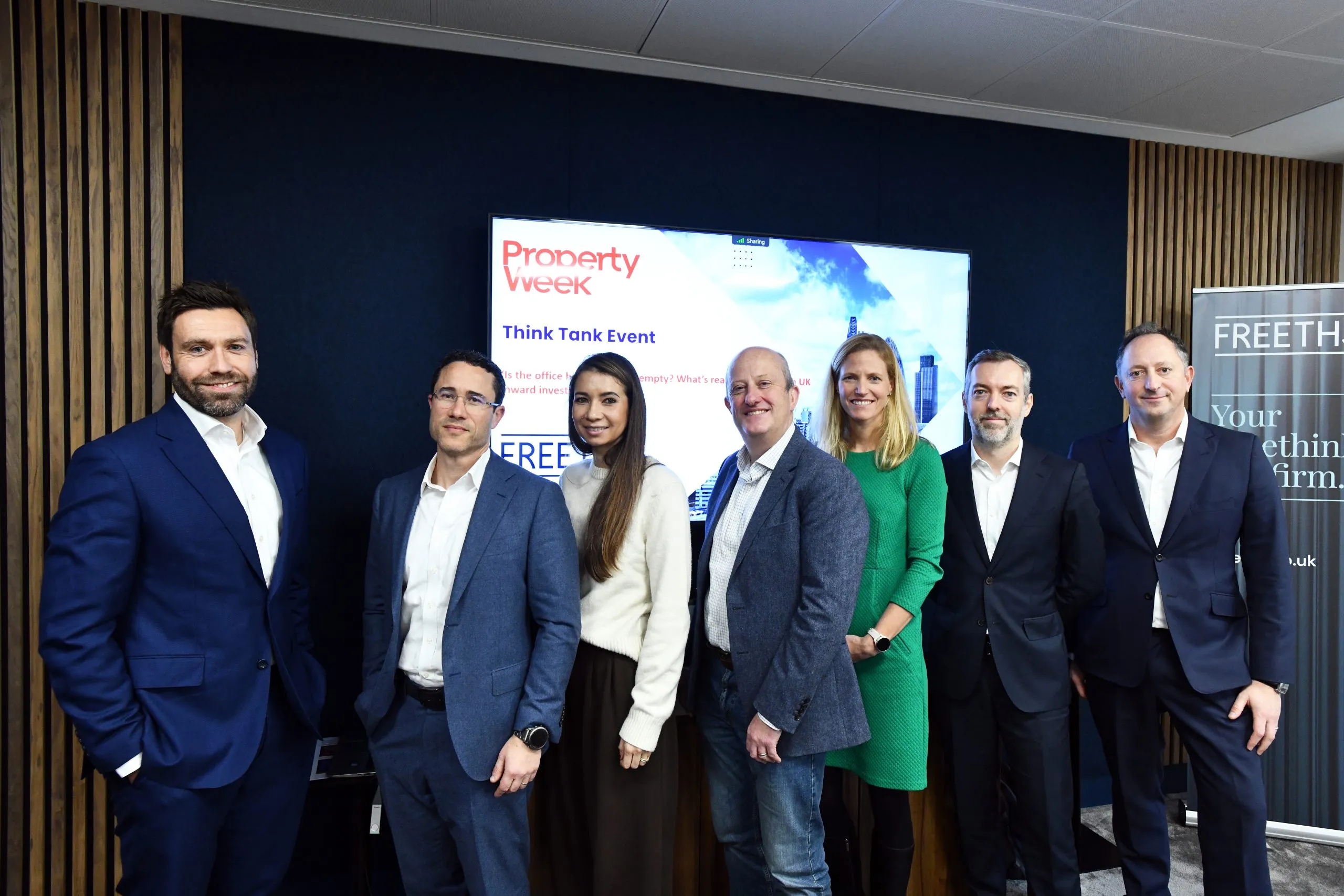
Expert panel
- James Abrahams, partner, commercial investment, Allsop
- Craig Jones, partner, real estate, Freeths
- Samantha Kempe, co-founder and chief investment officer, IMMO Capital
- Guy Lewinsohn, chief executive, Ashtrom Properties UK
- Hannah Marshall, chief investment officer, UK direct real estate strategies, CBRE IM
- Peter Riley, head of capital solutions and UK commercial, M&G Real Estate
- Chair: Andrew Saunders, contributing editor, Property Week

James Abrahams

Craig Jones

Samantha Kempe

Guy Lewinsohn

Hannah Marshall

Peter Riley
Following a turbulent 2025, where does UK office stock stand in the ranking of prime assets for footloose international capital looking for a sound and productive home?
To unpack the issues surrounding these and a number of other pressing questions, and to take the temperature of the UK office market both in London and beyond, we assembled a panel of key industry figures covering investors, operators and agents with interests across the country.
How attractive is the UK to international investors at present and is it still seen as a safe haven?
Hannah Marshall: There’s been a de-globalisation trend that started in Covid and has been accelerated by announcements such as trade tariffs. So, as a generalisation, for investors, it has probably felt safer to invest within their region than to go globally. That’s not a UK phenomenon – it is widely felt – although our economic outlook is arguably worse [than some other countries].
Higher and persistent inflation means that hedging costs are also high. These factors have caused a pause for thought, but we have still seen activity – the UK is still a core global market and as we have moved through the year, the UK and also Europe have come back into sharper focus for investors.
Craig Jones: The reason the UK has been seen as a safe haven for so many years is due to stability and the fact that our policy and legal framework are very robust. When that starts to be dislodged slightly, then I can understand investors becoming somewhat more hesitant.
However, if you take a step back, considering all the global instability, I think that the UK is still a fairly robust and stable place.
Peter Riley: If you are in the UK, there is a certain negativity around sentiment out there at the moment. There are challenges – such as inflation and the cost of debt – but if you look at cross-border [capital] flows, then the UK, and London in particular, remains a key destination. On a relative basis, compared with other competing destinations, the UK is very attractive.
James Abrahams: We have spent the past two or three years taking offices that were no longer fit for purpose and turning them into serviced apartments and hotels. But the flipside is that not much [new space] got built.
The story now is completely different to what it was 18 months ago – what we are seeing on the ground is a bit of a rebound.
 JP Morgan coming in for 3m sq ft [in a planned new HQ to be developed at Canary Wharf] is not to be ignored.
Margins have started to come in and we are regularly seeing rents – even in the City – of over £100/sq ft. That’s giving [investors] a bit of confidence.
Guy Lewinsohn: I think there has been a shift in the ability of investors to come in [to the London office market] with a short-term horizon. It used to be the case that if you bought into something in London, the value would go up no matter what you did. But now, if you want to be a value investor, I think you need a minimum [investment horizon] of five years, because the hockey stick [graph of sharply rising returns] just isn’t there.
Has there been increasing competition from other asset classes in recent years?
GL: Although there is a slight resurgence now, just about every other asset class has been more attractive than offices in the past two years. If you had said offices, especially to American investors, they would have been running for the hills.
I would say that some US investors have trouble differentiating between the office market in America and the office market everywhere else – the US has a very different dynamic; the market moves faster and drops faster. In San Francisco and New York, you’ve seen values drop by 50% on amazing prime stock with the best tenants in the world.
But now, I think ‘office’ is not such a bad word again all of a sudden and Americans are getting comfortable with investing in the UK again.
CJ: In the past five years, some of our US investor clients that would traditionally touch nothing but offices have been holding back on the sector. But they have not stopped investing in the UK; they have just switched their focus to other asset classes, primarily PBSA [purpose-built student accommodation] and retail.
Now that we are seeing a bit of a bounce-back in the office market, similar to what we saw in retail post-Covid, it will be interesting to see if their investment strategy flips back to offices once again.
Where is the capital coming from, and has that changed?
JA: Most of what we are doing [in London] now is new entrants; international capital from Turkey, Switzerland and Hungary. I have very few institutional clients who want to invest at the moment.
HM: The Germans have traditionally been big buyers of London offices, but they are very quiet at the moment. They have their own domestic issues; it’s not a London thing.
PR: In London, we see continued appetite from North American capital and Japanese investors continue to be active.
How do the UK regions compare with London as a draw for investors?
HM: London is a global city and it competes with other global cities – the choice that a lot of international investors are making is not London or Manchester; it’s London or Paris, Frankfurt, Madrid. And some of these investors are large – they want £100m-plus [deal size] and that stock is limited in the regions.
Counter to that, we have seen some phenomenal rental growth in cities like Bristol, Edinburgh and Manchester, because there hasn’t really been much development.
GL: We have about 1.5m sq ft of office space in the regions [Ashtrom’s UK portfolio includes assets in Leeds, Birmingham and Manchester], and we have seen phenomenal rental growth. So, on the operational side, things are great. Capital value wise, we’ll see, but I think underwriting is very difficult.
 Our strategy has always been cash-returning and operations-led. I’m a big believer in long-term value and I think there is a lot of long-term value in the regions. But you really need to do your due diligence when you are buying.
PR: London, as I think we all agree, is still very attractive. Liquidity is very important – if you are underwriting, probably the most difficult thing today is to put an exit cap rate [the ratio of expected sale price to forecast net operating income at the time of sale] on something. That’s difficult in London, but it’s more difficult outside [the capital], because of uncertainty about who the future buyer is.
JA: We handle a lot of inward Middle Eastern capital through our City group and we buy a lot in the regions. It’s for yield – it’s to offset what they have overpaid for in the West End. But [the key] is knowing how many exit strategies you have – we are happy with a £20m to £40m or maybe £50m [purchase price], but above that, it is tough.
Is office-to-resi conversion a viable alternative use for superannuated office stock?
Samantha Kempe: I am a bit of a wild card here today, because IMMO is in the residential space rather than offices. But a lot of what we’re doing in the UK is office to resi. We’re mostly focused around London, because you need the higher capital values to make it work. Ideally it’s about a 50:50 split between purchase price and capex.
We get sent new office-to-resi opportunities every week, but the problem is most of them don’t work. Many will just have PD [permitted development] rights, for example, whereas all our capital partners require full PD consents to be in place. For us, Germany is getting more interest than the UK – debt is a bit more accretive there.
How are such shifting occupancy patterns changing the office market?
Peter Riley: I think there’s a lot of anecdotal evidence about the [return to the office]. People talk about how busy the tube is and whether you can still get a seat on the train or a space in the station car park. But if you look at the survey data, it is improving. The number of respondents looking to reduce their space has gradually fallen. And on the other side of the coin, the number [of occupiers] in expansion mode has increased.
CJ: We’ve seen changes in the amenities that are needed to get people back in [to the office] and the way that space is used. It’s a flight to quality. But we have also seen changes to more flexible leasing structures, where traditionally, there might have been a five- or 10-year lease. And there’s been a slight uptick in management-agreement-style arrangements, where people can take the space they want. That can create a bit of a pinch point around the amount of grade-A space that is actually available in the market.
Are there any indicators that AI is affecting the demand for office space?
HM: I think it will affect different businesses differently. In discussions with big corporate occupiers, what they are thinking about is the uncertainty [that AI will cause] over the next 10 years: what will their workforce look like? What kind of space will be needed and how will it be used? Those questions are weighing quite heavily on the sector.
I think landlords have to shift their view and think of offices as more like resi and hotels – you’re providing a service, not just signing a lease. It’s about the amenities and the look and feel.
SK: The AI effect is not just about the workforce, but also the knock-on effect on revenues for a lot of companies. I know of one consulting firm that was about to start a £100,000 piece of work when the client said they had managed to do 80% of the work on ChatGPT, and that was good enough for them. And I know the founder of a media business who gets a lot of her revenue from advertising to users who come to her websites for content. But they are not coming to her websites for content anymore; they are getting that from ChatGPT, too.
So, there are a lot of occupiers who are still trying to figure out how to adjust their business models to take account of the impact of AI on revenues.