 Property Week News, analysis, insight and events for UK property professionals
Government responsibilities and reputational challenges concerning housing for older people were the key talking points at last week’s Later Living and Care Conference, hosted by Property Week at The Kia Oval in south London.
 Hundreds of professionals from across the healthcare and later-living spaces gathered to discuss the ups and downs of the industry, with delegates keen to discuss the impact of government policy and educating planners, plus the importance of community and public image.
The event got under way with a panel examining policy and how central and local government is shaping the future of housing and care provision for older people.
London’s deputy mayor for housing, Tom Copley, pointed to City Hall statistics that stressed the scale of the sector’s potential, with the number of Londoners aged 65 and over projected to rise by 60% by 2046. On top of this, the number of Londoners in that age range who rent is also set to rise from 6% today to 17% by 2040 – presenting opportunities for investors and developers, but also putting pressure on supply and rents.
“We’re going into a situation where, if we don’t get policy interventions right, potentially a lot of people will be renting much more expensive [accommodation],” Copley warned.
We need accommodation that’s fit for the future, but also need affordability
Nadra Ahmed, National Care Association
When asked if he thought government policy was delivering for older people, Lord Richard Best, chair of the All-Party Parliamentary Group on Housing and Care for Older People, stated bluntly: “No.”
He added: “Government is doing lots of good things in housing, but it just doesn’t get it in terms of older people’s housing and the spin-out benefits that come from that.
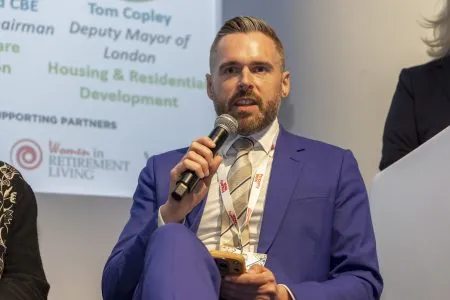
Tom Copley
“At the moment, [the UK is delivering] about 6,000 to 7,000 homes for older people each year. This is pathetic against a target of 300,000 homes a year. I can remember when 40% of all new social housing was specifically for older people, not least because it frees up family accommodation and that precious commodity of council housing at social rent.”
Best argued that older people’s housing should be more prominent in planning policy, specifically in local plans.
“If it was a requirement within a local plan that 10% of any development more than, let’s say, 500 homes has to be accommodation for older people, it would happen.
But at the moment, we see schemes of 1,000 to 2,000 homes all for young families, which has the by-product of separating out the generations.”
Promoting real change
This view was echoed by Deborah Heenan, chief executive of housing developer Populo Living, speaking later in the day. She said later-living and care home provision “should be part of the mix” when drafting planning applications, to bring about real change.
One possible solution was offered by Laurence Geller, founder and chief executive of Loveday & Co, who argued that tax incentives for developers and operators in the sector could boost supply and attract new investment.
“The government is taxing the wrong way,” Geller argued. “[Government could introduce] tax incentives, or other fiscal incentives to encourage people, whether it’s through local authorities, directly or a mixture.”
Meanwhile, Nadra Ahmed, executive co-chair of the National Care Association, highlighted the sector’s skills shortage as a key block to progress. She called on government to launch a “workforce strategy” to address “the complexity of healthcare tasks”.
Ahmed added: “We need accommodation that is fit for the future, but we also need some affordability in that, and its deliverability [will depend on] the workforce.
One of the biggest challenges is that we don’t have a workforce. The workforce I had in 1981 did not have to do what my workforce today are doing.”
Another key discussion point identified by delegates was later-living’s challenges in terms of reputation and educating local planners about the importance of the sector.
Heenan said there is “still suspicion” from planning authorities when including housing for older people in their local plans.
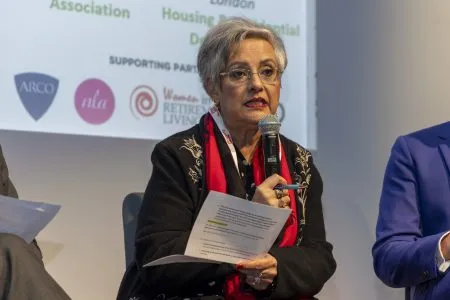 She added: “I commissioned a map of council housing where the head of the household was over 55 and there [was only one person] living in the house. And then we did an analysis to say that if you build these homes, these are the benefits. When we got over that hurdle, it became much easier. But the struggle at the very start was communicating to the right people in different silos what the strategic and delivery options would be.”
According to Steve Bangs, chief executive of Pegasus Homes, it is “all about education”. “There is always a stigma associated with [later living] and I think it’s our job to explain the benefits of it and the diversity of opportunity,” Bangs said.
Philippa Kellar, later-living director at BUPA, added that while there are sector-wide misconceptions, these are most acutely felt by the care home sector.
“It’s really important that you make sure that [care homes] are not seen as a negative. They are absolutely part of the community, something the community is proud of.”
Stigma is fading
However, Bangs said he believed the stigma around the later-living sector is beginning to fade, with the rise of more of what he termed “younger, older” residents.
He added: “The younger, older customers were the pioneers of rental. They didn’t leave home and go straight into home ownership; they went into rental. So, the thought of moving into a rental community in later life, for that target market, is not alien to them, and I think they welcome the opportunity to be part of a community in later life.”
Throughout the day, many delegates cited the importance of community, which they argued could not only drive demand for later-living schemes, but also support the health and wellbeing of residents.
Bangs said it was imperative that later-living operators use “a fairly light touch” and foster independent living, which in turn creates a better sense of community.
“We [offer] truly independent living, and when our customers move in there, they’re fiercely independent, they don’t want any sort of undue interference from our staff. But our staff are there, and they’re an extension of the community. We’re there to facilitate the best life that our customers can have within our community, without interfering.”
But he also warned that this approach could create financial viability constraints, which in turn could be placed on residents: “That does come at a premium, because the facilities the community shares have to be paid for, and they have to be paid for by a smaller number [of residents] than our open-market equivalent.”
BUPA’s Kellar said curating a sense of community can also be used as a model for bringing both later living and care together.
“It is about trying to keep people [independent] as long as possible, but recognising that some will need additional care, whether that’s in their own home, or whether that may be in a care home.
“One of the great aspects of a care home on site is that we have quite a few couples who are going through a different journey. Being able to stay together on one site is incredibly important for them.
“We also see people come into our villages, into the care homes, then improve and move into apartments. Wherever you are on that journey, it’s about where is the right place for you to fit in.”