 Property Week News, analysis, insight and events for UK property professionals
Half way through the decade and a quarter of the way through the century, 2025 is a milestone year. So, what better time to take stock of the progress of the proptech sector.
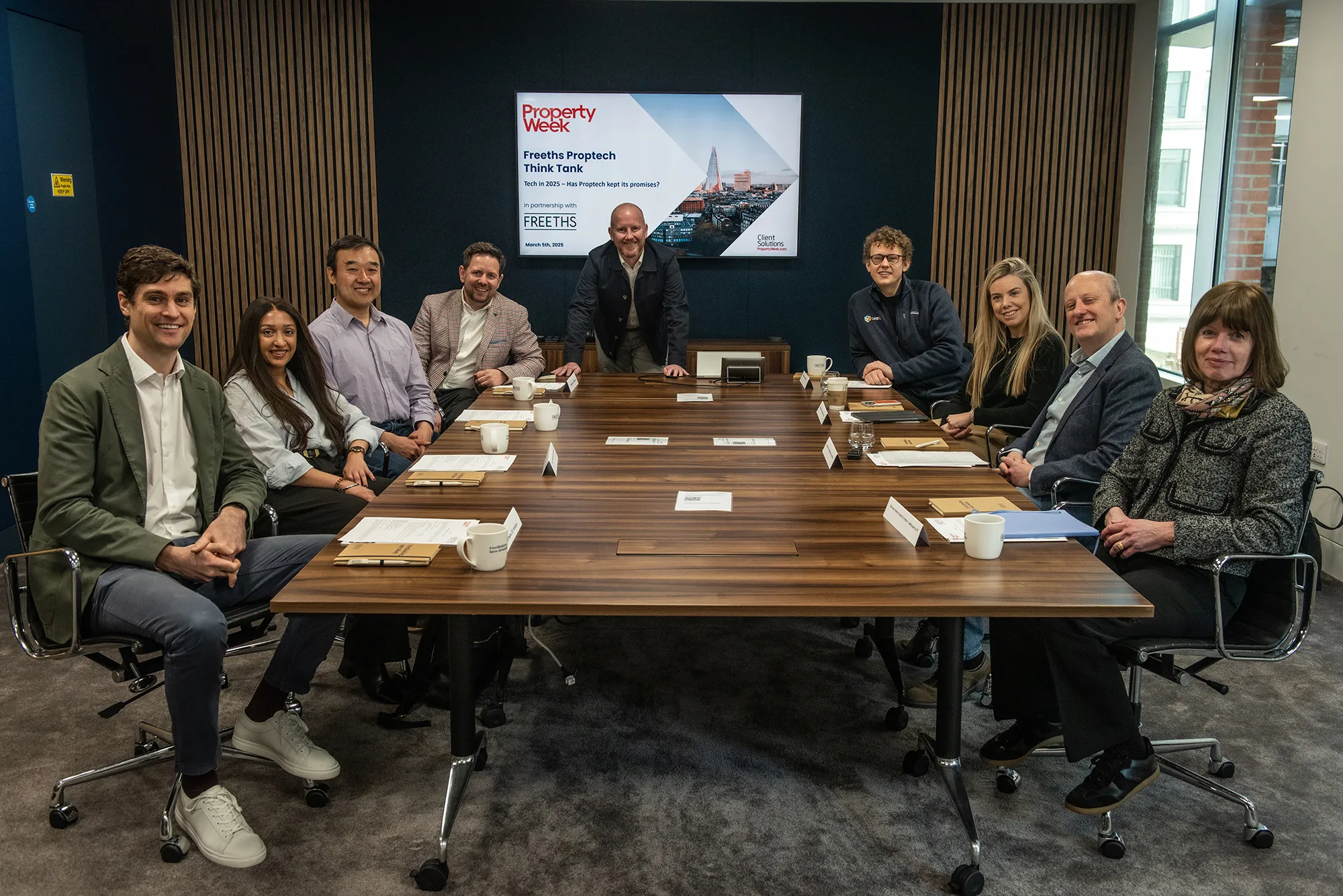
Expert panel
- Matt Stephens – partner, Freeths
- Jimmy Jia – venture partner, ESG, Pi Labs
- Sally Jones – head of Europe, SwiftConnect and VC partner, PT1
- OIlie Kilvert – founder, The 360 View Service
- William Newton – chief executive, WiredScore
- Sammy Pahal – managing director, UK PropTech Association
- Will Pearce – chief executive and co-founder, Orbital
- Katie Whipp – global head of partnerships, re:sustain
- Chair: Andrew Saunders – contributing editor, Property Week

Matt Stephens

Jimmy Jia

Sally Jones

Ollie Kilvert

William Newton

Sammy Pahal

Will Pearce

Katie Whipp
Now estimated to be worth over $40bn globally, proptech has come of age during a period of unprecedented change including the pandemic, the energy crisis, rising interest rates and spiralling geopolitical uncertainty.
Against this turbulent backdrop, Property Week and Freeths assembled a panel of experts from all walks of proptech life to offer a mid-term report on the sector and answer the question: how well has proptech kept its promises?
Looking back five years to 2020 when proptech was still a nascent sector, how have priorities changed in the industry?
Matt Stephens: For me, I think there has been a big shift from necessity to advantage. Five years ago, the big questions people had about proptech were: can we make it work? Can we actually do this? Now, those questions have moved on to: how do we make it faster? How do we make it good value? How do we use it to really drive forward? I think that is quite a fundamental change.
William Newton: Five years ago, we knew what adoption curves in other industries looked like and we assumed that proptech would follow a similar, relatively linear path. What we have actually seen is wild variance. We have seen the most unexpected circumstances that any of us could have imagined, from Covid to the generationally terrible economic conditions in real estate over the past couple of years.
So, the proptech sector has had to evolve to deal with a much higher level of uncertainty and a much less linear growth path than expected.
Katie Whipp: One thing that proptech companies have got much better at is thinking about business cases on the customer side. In 2020, I was at CBRE and I got sold a lot [of proptech solutions] that were not relevant to things that really mattered to us and the problems we were trying to solve as a business.
Since capital became harder to get in 2020-21, proptech has definitely started to look at this. It is a really positive change that will help with traction in the longer term.
Sammy Pahal: Another shift we have seen is in the way the property industry measures return on investment. We recently had a discussion in our Innovation Leaders forum, and it is no longer just about increasing efficiencies. It has become more about the value that technology can bring, whether that is asset value, rental value or by opening up new revenue streams.
One thing we are still not seeing is the [willingness] to scale. Organisations have an innovation budget to do pilots, but scaling is harder.
Sally Jones: I would posit that the economic circumstances have reduced valuations and squeezed the profits of property companies, so they become less willing to put money into trialling new technology. The same economic trends have impacted VC [venture capital] investors in particular, so they are less willing to fund endless losses in proptech.
The next revolution will be AI-powered robotics, which will impact the construction of real estate assets
Will Pearce, Orbital
I think we may go to something more traditional where [proptech start-ups] have to think about business models that make money earlier in the cycle. It will be interesting to see how that plays out.
Ollie Kilvert: I first got into technology in 2016. I was living in Sheffield and I managed to sell a house there to someone in Singapore. It worried my wife a bit at the time! Now, at The 360 View Service, we use our technology for a whole host of things. We work with a facilities management company to detect the cleanable surface area within a certain space, for example, and our AR [augmented reality] technology can help users navigate through airports and shopping centres.
Amid all the uncertainty, the potential of artificial intelligence (AI) has been one constant in proptech. Is it now delivering?
Will Pearce: Like a lot of other people at the forefront of AI, I have been tremendously surprised at the pace of development. That has been outstanding and we will continue to be surprised by the upside. In the domain I sell to [real estate legal services], we are seeing products created in a matter of days that outperform incumbent technology that has existed for decades.
Even three and half a years ago, building AI products and AI businesses was expensive and complicated. Now, we have a paradigm shift that just by using an API call [a request for information from one programme to another] anyone can access some of the most intelligent models that people have ever produced, so [technology] that was the preserve of PhD data scientists is available to anyone with an idea.
Sam Altman, chief executive of OpenAI, said [in 2024] that the first one-person billion-dollar business to be founded by just one individual would be founded that year. That is a transformation that will impact real estate and could be pretty existential. I think those who do not adopt AI will be wishing they had.
WN: I do agree with you [about the potential of AI], but I don’t think that the first billion-dollar one-person company will be deploying in commercial real estate, and I don’t even know that having lots of fantastic AI-driven proptech solutions will drive adoption at all.
 The difficulty of proptech adoption is that the risk of not being an early mover is really pretty small – you can let someone else do the big innovation and then copy it later on. I don’t think [the threat of AI] is existential at all. Property doesn’t work like that – it is not a winner-takes-all environment.
Jimmy Jia: Property is an industry that values reliability and consistency very highly, and property people are probably more comfortable adopting technologies from five years ago. But of course, technology has moved on so there is now new technology that might take another five years to adopt.
We need to be aware that technology can be confusing. It is hard for customers to differentiate the truly innovative things AI can do that [its predecessors] big data and machine learning could not.
MS: In our industry [property law], I think adoption [of AI] is a ‘when’ not ‘if’ across the board. There will come a time when everyone has it, and in the meantime if you don’t adopt quickly enough you will be less profitable.
SJ: There is a difference between small, high-volume transactions and big, high-value ones, though. The former have already become much more automated; but for the latter, there is going to be resistance from the client simply because of the value involved. Given the complexities that they have to deal with [on large complicated transactions] can technology really replace the brain power of the best lawyers?
Is proptech helping to drive a more customer-focused and relationship-based approach to growth?
WN: As Sammy [Pahal] has said, we are seeing some of the best landlords in the world starting to say they are here to try and create fabulous customer experiences, and that they view themselves as customer experience companies. Things that can underpin that are a great tenant experience app, for example, or great access control. So, technology can be part of the solution but it relies on property companies driving value through customer experience rather than by just being builders.
JJ: Real estate has always been relationship-based; but because of technology, the networks and interactions have changed. The industry is discovering constituents they did not even know were there and who now have a voice because of technology. The winners will be those who can identify and satisfy those new constituents first.
SP: There is a general acceptance among the organisations we speak to – which do tend to be larger corporates – that you need a tenant experience app to engage with tenants about the amenities in a building; you need predictive maintenance. These things are just becoming standard.
KW: There is a shift where real estate is starting to be seen as a platform of services where the value creation and growth will be very different. But arguably we are also stuck trying to digitalise and drive efficiency, because that is where everyone is comfortable.
How seriously do business leaders in 2025 take the power of proptech? Does it deserve a stronger voice in the boardroom?
WP: There is a vast range of proptech companies and a vast range of boardrooms, so it is hard to generalise. But I am sceptical when there is a nominated champion. You want a general appreciation [of technology] that is anchored in the CEO, the decision-maker, rather than someone who is wheeled in to join discussions on technology that the others may or may not listen to.
Adoption of proptech has been lamentable over the past five years and we have seen shockingly few building technology companies scale above £10m revenue
William Newton, WiredScore
JJ: It is important to have a broad understanding [of technology] in the CEO and at the C-suite level generally. But the board is a governance function; it is about whether there are risks and whether you have oversight of the functionalities of those risks. There is no obligation for every single board member to be a deep expert.
SP: If boards are talking about AI or investing in technology, is it not helpful to have someone who understands [the technology] and can influence at that level? We are seeing more chief information officers getting support from the CEO to upskill their teams. SEGRO, for example,
has a digital academy – the CIO there has come from outside the [property] industry and is used to working on big digital transformation projects.
What big trends in proptech should we look out for in the next few years?
WP: The number and pace of products coming to market will grow exponentially. And there is an enormous and growing gap between capability and adoption, which is a real shame. The next revolution will be AI-powered robotics, which will impact the construction of real estate assets.
OK: I am also working with a start-up that we are just getting off the ground that is looking to use solar films to re-engineer the glass facades of buildings. The technology has been in use for 10 or 15 years, but I discovered someone – let’s call him a mad Welsh inventor – who has discovered a way of adding a certain pigment so that the film massively outperforms other films currently on the market. It is a huge opportunity to save
energy and reduce costs.
SP: There is more interest coming through from government in proptech, particularly from MHCLG [the Ministry of Housing, Communities and Local Government]. So, are there policies that need to be put in place to help build new homes more quickly, provide more affordable homes, digitalise planning to unlock developments? They are making that link and there is buy-in from senior government officials to do that.
What is your overall verdict on how well proptech has kept its promises?
WN: The adoption of proptech has been lamentable over the past five years and we have seen shockingly few building technology companies scale above £10m revenue. One of the many reasons for this is that real estate buying decisions are delegated down to individual asset managers. It is a structural issue that means even with great technology, adoption will always be slow.
KW: I think that proptech has [kept its promises], but I wonder if real estate has been ambitious enough? You need to figure out what your business case is, what your outcome is and whether there is a technological route that can help you get there faster, more sustainably and cheaper.
