 Property Week News, analysis, insight and events for UK property professionals
Artificial intelligence (AI) has long supported pharmaceutical development. The rise of generative AI is now pushing life sciences companies to rethink how they integrate it. Google DeepMind, for example, has been at the forefront of AI-driven drug discovery with AlphaFold, an AI programme designed to sequence amino acids into strains of protein. This technology solved problems that would have taken researchers decades. So, it seems like a no-brainer for life sciences companies to invest more purposefully in AI.

Jordan Mason
In the year to February 2025, the UK exported £24.7bn worth of medicinal and pharmaceutical products, making it the country’s third-biggest export. The government has bold plans to make the country a life sciences superpower. The UK has the talent to achieve this and, given the uncertainty of tariffs, committing to this market will be advantageous.
Meanwhile, cloud-based AI platforms are gaining traction in the life sciences sector. These allow labs to use computing power via the internet, which has several advantages including rapid scalability, reduced physical infrastructure and, in some cases, lower onsite power consumption.
However, given the sensitivity of drug discovery and patient data being stored in what is essentially another organisation’s system, there are risks. Data transfer via the cloud can result in latency (the delay between processing and response), which can be costly when undergoing time-sensitive experiments.
This has led to a growing trend of hybrid solutions, where labs combine cloud-based services with onsite high-performance computing facilities and edge computing. The benefit of this system is that critical workloads can be kept on the premises, with the cloud enabling dynamic scaling as needed. But a hybrid system changes the requirements for physical space, introducing the need to design labs with both systems in mind.
So, how does this influence the design of buildings? High-performance computing requires larger volumes of power, not just for processing but for mechanical cooling. Buildings need to be designed to handle these loads. Additionally, a reliable and robust high-speed network to transfer large volumes of data to the cloud should be prioritised.
In the UK, power availability is a national issue. This is a big design challenge, particularly as science parks and hospitals that would benefit from AI tools are located in areas with grid constraints. As science clusters continue to develop, the problem is likely to compound, adding increased pressure.
Carbon-conscious building design
Taking steps to design buildings to be more resilient and with AI capabilities in mind is vital. With the growing trend for speculative labs, developers and landlords should factor in their buildings’ potential to accommodate AI-driven drug discovery. This can be done by checking how power-resilient their buildings are.
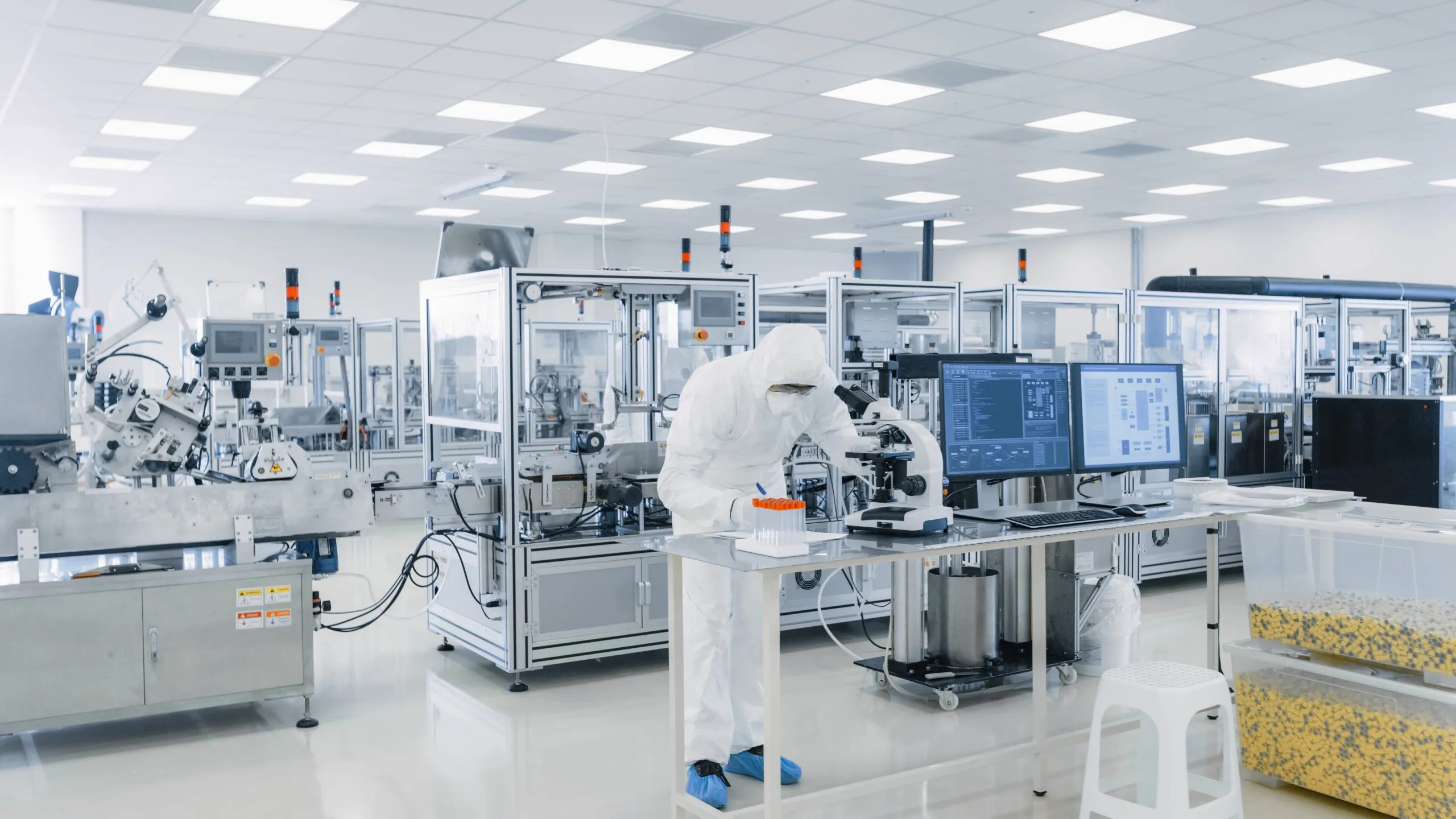
Credit: Shutterstock / Gorodenkoff
Carbon-conscious design should be at the forefront of all developments. Resilient, power-intensive research facilities with both flexibility and future-proofing in mind are notoriously carbon-intensive. Striking a balance between these requirements will, therefore, be crucial.
As AI continues to revolutionise industries like drug discovery, the buildings must also evolve. These structures need to be resilient, flexible and in locations with sufficient grid capacity to meet the needs of their tenants. With buildings designed in this way, the UK can continue to
lead as a pharmaceutical superpower, performing life-saving work.
Jordan Mason is associate director at Cundall